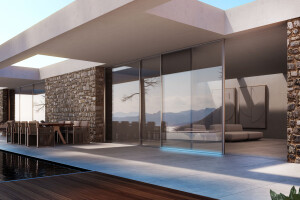
Curved façades combine a distinctive architectural appearance with maximum transparency and natural daylight. Their flowing form creates unique glazed façades that strengthen the connection between indoor and outdoor spaces while offering architects greater design freedom.
In this article, we explore what a curved façade is, the technical challenges involved and why this bespoke solution is increasingly being used in exclusive residential projects and high-end architecture.

What are the benefits of curved façades?
A curved façade is distinguished not only by its shape, but also by the spatial quality it adds to a building. Without sharp corners interrupting the façade, sightlines flow naturally, creating panoramic views of the surroundings.
This makes curved façades particularly suitable for homes overlooking water, natural landscapes or urban environments.
Large glazed surfaces also maximise the amount of natural daylight entering the building. Daylight can penetrate deeper into the interior, making spaces feel lighter and more spacious.
Combined with slim aluminium profiles, the emphasis remains on the views and the architecture rather than on the supporting structure.
The key benefits of a curved façade include:
- maximum design freedom for architects;
- an exclusive and distinctive appearance;
- abundant natural daylight and an open, spacious feel;
- a seamless transition between indoor and outdoor spaces;
- bespoke solutions tailored to the architectural vision of the project.
For Metaglas, achieving the right balance between aesthetics and engineering is always essential. A curved façade should not only make a strong visual statement, but also deliver reliable performance for many years.

Where are curved façades used?
Curved façades are primarily used in projects where architecture plays a defining role.
Typical applications include exclusive villas, waterfront homes, luxury renovations and prestigious commercial buildings such as showrooms, hotels and high-end offices.
In these projects, a curved glazed façade can contribute significantly to a building's distinctive identity and premium architectural appearance.
Because every location and architectural design is different, there is no standard solution. The required radius, dimensions, glass composition and detailing must be tailored to both the architectural concept and the technical requirements of the project.

This is precisely why a curved façade requires close collaboration between the architect, structural engineer and façade specialist.
How is a curved façade designed?
A successful curved façade starts at the initial design stage.
The shape of the façade influences the supporting structure, glass production and detailing of the aluminium profiles. By considering these factors early in the design process, architectural ambitions and technical feasibility can be optimally aligned.
The design process generally involves determining the required radius, developing the structural details, producing the curved glass and aluminium profiles, and finally installing the façade on site.
Every stage requires a high degree of precision, as even minor deviations can have a significant impact on both the performance and appearance of the façade.
Metaglas therefore contributes its expertise from the very first design drawings. By bringing design and engineering together at an early stage, a bespoke solution can be developed that combines transparency, slim detailing and architectural freedom.

Practical advice from Metaglas
The most important decisions for a curved façade are made during the initial design phase.
The selected radius, glass composition and profile connections determine not only the appearance of the façade, but also its technical feasibility.
Involving a façade specialist early in the design process makes it possible to achieve the optimum balance between design freedom and technical feasibility.
Distinctive architecture without compromise
A curved façade gives architects and clients the opportunity to create buildings with a distinctive identity without compromising on transparency, daylight or spatial quality.
By combining curved glass, slim aluminium profiles and project-specific engineering, it is possible to create a façade that is both aesthetically compelling and technically sophisticated.
As every curved façade is unique, detailed technical development from the outset is essential.
Metaglas therefore supports architects and clients during the design phase in developing bespoke aluminium and glass solutions that meet both the architectural ambitions and technical requirements of the project.
In this way, complex concepts can be transformed into feasible glazed façades where design freedom and craftsmanship come together.

Does curved glass affect the view?
An important consideration when specifying curved glass is optical distortion.
Because of the curvature of the glass, reflections and views through the glazing differ from those experienced with flat glass.
The degree of optical distortion depends on several factors, including:
- the radius;
- the type of glass;
- the glass composition;
- the coating or coatings;
-the glass thickness;
- the selected manufacturing method.
These factors should therefore be considered during the design and engineering process, particularly in projects where uninterrupted views and visual quality are key elements of the architectural concept.