Sustainability Report
Embodied carbon
The building meets the requirements of the EEWärmeG (Renewable Energy Heat Act) by 340.1 percent, indicating that it uses significantly more renewable energy for heating than is required by law. EEWärmeG is a German law that aims to encourage the use of renewable energy sources for heating purposes, thereby contributing to a reduction in the country’s greenhouse gas emissions.
The building surpasses the energy efficiency standards established by the 2016 German Energy Saving Ordinance (EnEV). Its primary energy demand is 89.9 kWh/m2a — the required value is 127.2 kWh/m2a.
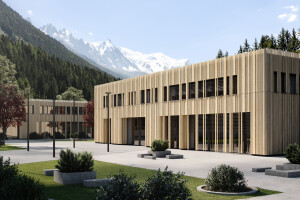
The building’s construction and support structure make extensive use of mass timber components. The distinctive canopy is made with orthogonally screwed wooden lamellas, charred using shou sugi ban, a traditional Japanese method of preserving wood. This “Timber Hat” provides shelter from direct sunlight and the elements.
Operational Emissions / Energy
- Wood is used throughout the building, externally and internally, creating a diffusion-open wall structure. This allows for the movement of moisture and air, promoting natural ventilation, enhancing energy efficiency, and improving indoor air quality.
- Rundzwei Architekten prioritised recyclable and biological building materials, avoiding composite materials and construction foams.
- A green roof covers a large part of the roof area. This reduces internal temperatures in warmer months and increases insulation in colder months. The green roof contributes to biodiversity and rainwater harvesting. Rainwater is collected in a cistern and used to water green areas and clean rental equipment.
- The building is insulated with wood insulation materials, helping to maintain low-energy standards.
- A combined heat and power (CHP) plant, powered by biogas, supplies heat to a component-activated industrial underfloor heating system in the factory hall. In the office section, floor convectors supply heating and cooling via an absorption chiller linked to the CHP unit. Electricity generated by the CHP unit is used in the building and to charge electric vehicles.
Afterlife
As far as possible, all construction materials were mechanically fixed to promote a circular economy.
Key products in low carbon design