Sustainability Report
Custom Certificates
Operational Emissions / Energy
Operational carbon emissions are estimated at 28.21 kg CO₂/m² per year, according to the Italian Energy Performance Certificate (APE).
The building achieves energy class A2 through high-efficiency electric heat-pump systems for heating, cooling, and domestic hot water, together with mechanical ventilation.
The assessment is based on standard-use conditions and includes the building’s regulated energy services.
Afterlife
The project is itself an adaptive reuse of an existing historic building, whose original masonry structure and spatial identity have been preserved. The intervention introduces contemporary hospitality and cultural functions without compromising the building’s long-term adaptability. Existing rooms remain clearly legible, while services, lighting and furnishings are organised as largely independent layers.
This approach allows the spaces to accommodate future residential, hospitality, exhibition, or cultural uses with limited structural alteration.
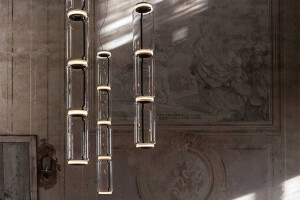
Several contemporary components are designed as removable and potentially reusable elements, including freestanding furniture, lighting tracks and fixtures, exhibition equipment, decorative elements, and selected service components. Their predominantly dry-mounted or non-structural installation allows them to be maintained, replaced or relocated without damaging the historic fabric.
The project’s principal circular strategy, however, is the retention and continued use of the existing masonry structure, extending the life of the building and avoiding the material impacts associated with demolition and reconstruction.
Key products in low carbon design