Sustainability Report
Certificates
LEED • Gold • BD+C
V4
Embodied carbon
Low Carbon
Vantage Development implemented significant design strategies to reduce embodied carbon, with quantifiable results from a Life Cycle Assessment (LCA):
- Quantified Reductions: A life-cycle assessment (LCA) conducted by Thornton Tomasetti demonstrated measurable reductions in Global Warming Potential (GWP) and other impact categories. These reductions exceeded the LEED v4.1 requirement of a minimum 5% reduction in at least three impact categories, including GWP, to achieve two LEED points.
- Building A: Achieved a 7.8% reduction in global warming potential, 7.1% reduction in eutrophication, and 15% reduction in depletion of non-renewable energy resources.
- Building B: Achieved a 5% reduction in global warming potential, 6.8% reduction in depletion of stratospheric ozone layer, 11% reduction in eutrophication, and 12% reduction in depletion of non-renewable energy resources.
- Amenity Building: Achieved an 18% reduction in global warming potential, 17% reduction in depletion of stratospheric ozone layer, 16% reduction in eutrophication, and 23% reduction in depletion of non-renewable energy resources.
- Cementitious Material Replacement: A key strategy involved increasing the use of cementitious material replacements in concrete. Specifically, 30% replacement was used in normal-weight concrete for foundations, footings, slabs, walls, beams, and columns for Buildings A and B. Lightweight concrete in these buildings incorporated 40% replacement. The Amenity Building aimed for an even more ambitious 50%-70% cement replacement in all structural concrete.
- Low-Impact Sourcing for Steel: The project prioritized procuring steel reinforcement and steel deck products with lower environmental impacts compared to industry averages. This includes using products from manufacturers like Clark/Dietrich Steel Framing Systems.
- Environmentally Friendly Roofing: Selection of PVC roof membrane products with lower environmental impacts compared to industry averages, such as Sika Sarnafil G410 Feltback Adhered System.
- Lower-Impact Sheathing and Roof Boards: Choosing glass-mat deck sheathing panels and roof board products (like Georgia Pacific DensDeck Prime Roof Board with EONIC technology) that demonstrated lower environmental impacts compared to industry averages.
- Recycled Content: Emphasis was placed on using materials with recycled content to support sustainability and reduce the carbon footprint, notably in the rock wool insulation batt or board used for the roof and walls of the amenity building.
- Efficient Construction Practices: The project aimed to minimize waste through efficient construction practices, promoting long-term durability.
Operational Emissions / Energy
Low Carbon
Vantage Development incorporates comprehensive high-performance building systems to optimize energy efficiency and significantly reduce operational emissions:
- High-Performance Envelope & Glazing: The exterior glazing employs articulated fins, frit patterns, and solid spandrels, designed to maximize solar heat gain in winter months, minimize heat gain in summer months, and optimize daylight illumination onto the floor plate year-round. This strategy directly reduces HVAC system and artificial lighting energy loads. Reflective roofing also contributes to lowering cooling demands by reducing the heat island effect.
- Efficient HVAC Systems: Energy-efficient HVAC and MEP systems are employed across all three buildings. Buildings A and B feature 96% efficiency boilers with a 30°F design delta temperature. Runaround coil heat recovery systems capture 50% of sensible heat from exhaust air. VAV (Variable Air Volume) boxes reduce supply airflow to 30%, which significantly cuts reheat energy use. Together, these strategies resulted in a 60% heating energy reduction compared to the ASHRAE 90.1-2010 baseline.
- Smart Building Management & Commissioning: A monitoring-based Cx (Commissioning) plan and real-time BAS (Building Automation System) data collection are in place to ensure ongoing operational efficiency and optimize building performance.
- Efficient Lighting: LED lighting is used throughout the campus to reduce electricity consumption for illumination. If tenants adhere to Title 24 2019 prescriptive standards, the project anticipates approximately 40% energy savings on lighting.
- Renewable Energy: The project incorporates photovoltaic cells to generate on-site renewable energy, further reducing reliance on grid power and lowering operational carbon emissions.
Service and maintenance emissions
Efficient
The project integrates elements that contribute to reducing service and maintenance emissions over its lifespan:
- Durable Materials: The selection of robust materials such as Sika Sarnafil G410 Feltback Adhered System for roofing, Georgia Pacific DensDeck Prime Roof Board, and Forbo PVC-free modular tile (Marmoleum Modular) for flooring implies a focus on longevity and reduced need for frequent replacement or intensive maintenance. The exterior wall is composed of durable metal panel cladding with large glass openings.
- Optimized Building Systems: High-performance HVAC and MEP systems, coupled with continuous monitoring through the BAS and a commissioning plan, aim for optimized system performance, potentially leading to fewer breakdowns and more efficient, less resource-intensive maintenance.
- Sustainable Landscape: The campus's landscape design features 80% adaptive and 20% native species, including a pollinator garden. This approach supports biodiversity and is designed to require 75% less outdoor water use for irrigation, significantly reducing maintenance needs (e.g., less watering, less mowing, fewer chemical inputs) compared to conventional landscaping.
Afterlife
Adaptive Reuse and Flexible Design Considerations
Adaptive reuse was not a consideration for this new build. However, laboratory spaces feature large floor-to-floor heights, flexible floor plans, ceiling mounted outlets, and mobile lab benches designed to support future changes in tenants and configurations without the need for major renovation.
Key products in low carbon design
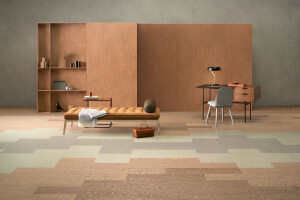
CO2
Marmoleum Modular
Forbo Flooring Systems

CO2
DensDeck® Prime Roof Board
Georgia Pacific


CO2
Clark/Dietrich Steel Framing S...
ClarkDietrich
Share or Add Healthpeak Properties Vantage Campus to your Collections