Train architecture
An overview of projects, products and exclusive articles about train architecture


Project • By Adriano Pimenta Architects • Transports
Campanhã High-Speed Train Station
This competition proposal for the new Campanhã High-Speed Rail Station in Porto envisions a future-proof mobility hub integrated into the city’s urban fabric. Developed for Infraestruturas de Portugal (IP), the project combines architectural clarity with technical precision, emphasizing sustainable infrastructure, urban permeability, and the reinvention of public space around one of Porto’s key transport nodes. Through a collaboration between three architectural studios and leading engineering firms, the design strategically merges the station’s functional complexity with an understated civic presence, framing the arrival of high-speed rail as an opportunity for urban regeneration and intermodal fluidity. More


Project • By JC. Architecture & Design • Transports
The Moving Kitchen
In Feb 2019, the Taiwanese society criticized heavily an expensive yet unsightly new tourism train. Forus, JC Architecture, instead of complaining, we wrote an open letter with encouragement and positivity to tell the Taiwanese society that Taiwanese designers can make a change. It led us to the opportunity to designTaiwan’s first-ever tourist train, “The Future,” eventually awarded the Japanese Good Design Award.
李國民攝影工作室 Kuomin Lee
Recently, JC Architecture reimagined everyone’s impression of a train, building the first railway kitchen in Taiwan, named “The Moving Kitchen.” The logo of it, “R,” stands for “Restaurant, Railway, Reimagination,” we want to create a language th... More
News • News • 30 Mar 2021
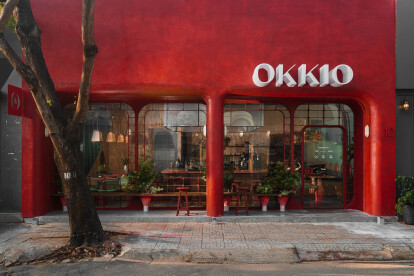
The strikingly red and retro Okkio Caffe exudes a strong brand identity
With a striking red exterior and a retro-spirit inspired by the spatial qualities of train carriages, Okkio Caffe in Ho Chi Minh City exudes a strong brand identity.
Đỗ Sỹ
The design by REDS Studio is inspired by acclaimed director Vuong Ga Ve’s ‘2046,’ a famous film about the return train from 2046. The building’s façade is designed with train-like windows, complete with iron bars as a highlight feature. Inside, the ceiling takes on a curved shaped similar to that of a train carriage interior. The windows draw in natural light in a way that highlights the counter and the ceilings, the two key components of the building.
Đỗ Sỹ
Alongside the train narrative and forms, traditional materials su... More