Archaeological site
An overview of projects, products and exclusive articles about archaeological site


Project • By STARTT • Heritages
Pantheon - Micro architectures for archaeology
Mario Manieri Elia, renowned historian of Italian architecture, described the image of the Pantheon—resulting from the union of the marble front of a Greek temple and the concrete vaulted cylinder of Etrusco-Roman origin—as an embodiment of the idea of the Roman State, founded on the union between Greek culture and Roman technique. At least from this moment onward, architecture could no longer be reduced to a purely constructive problem: the design of spatial forms became a medium through which the values of collective life are communicated. It is also for this reason that the Pantheon stands among the most famous architecture in the world—an icon represented and narrated in its autonomous condition as an isolated monument... More
News • News • 30 Nov 2022
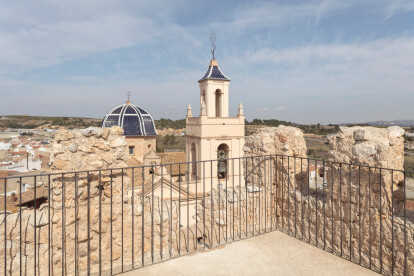
Hidalgo Mira Arquitectura restore the historic Godelleta tower in Valencia, Spain
Estimated to be built between the period of 11th and 13th centuries, the Godelleta tower is a Building of Cultural Interest (BIC) under the category of a monument, the highest degree of protection bestowed on a historic building by the Valencian legislation. Restored by Hidalgo Mira Arquitectura, the structure comprises a quadrangular plan at the base that tapers towards the top, resulting in a truncated pyramid-shaped volume.
Milena Villalba
The 16m high tower has a wall thickness of roughly 1.30 m at the base, gradually decreasing to only 55 cm at the battlements as it ascends. The first phase of the restoration process involves the structural consolidation of the tower like patching up cracks with fibreglass rods to assimilate... More


Project • By GTRF Tortelli Frassoni Architetti Associati • Museums
CHROMATIUS HALL
The project is a result of an international competition for the definitive organization of the entire monumental area of the city, after years of debate and various trials, and represents the first significant proposal for the protection and enhancement of Aquileia’s archaeological sites.The two squares, one stone-paved and the other green, trace the plans of the ancient buildings which originally belonged to the basilica complex: the post-Theodoric quadriporticus and the large Costantinian warehouse. The new addition to the southern chamber of the baptistery has the same layout as the original construction, and offers the only effective means of protecting the site, preserving and making accessible to the public the remains of important 4t... More


Project • By GTRF Tortelli Frassoni Architetti Associati • Museums
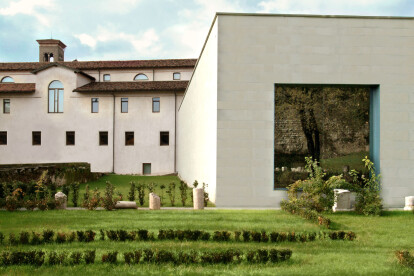
DOMUS DELL'ORTAGLIA
The architectural addition to the Santa Giulia Museum, which serves to protect the Roman domus brought to light under the kitchen garden of the ex-monastery, externalizes and amplifies the language and character of the Museum, emblematizing it and forming a direct link with the town.The nature and importance of the archaeological remains, and their location and relationship with their context, were crucial influences on design decisions, making the identity of extension and place, architecture and urban fabric, the starting point. The new construction, with its essential geometry, is in grey sandstone – the same stone with which are paved the streets and courtyards of the buildings that grew up over the remains of the Roman city – with a st... More


Project • By Enrico Realacci Architectures • Museums
Roof covering of the Auditorium of Hadrian
A transparent cover that has as primary purpose to protect the archaeological site but also and just as important, to fill the void created by the excavation; "heal" the ground.
Digging, exploring our roots to establish our unbreakable bond with the place, with the earth, the rock, our history. And then cover, protect, close the wound, through the construction of a "limen" - the transparent cover - that will allow us to think of both an inside and outside, a before and after. And to paraphrase Wittgenstein the ability to explore them both.
The project takes all of this into account and has produced a cover that, while communicating with the elliptical shapes and concave-convex arrangement of the twentieth century, becomes an element of re... More