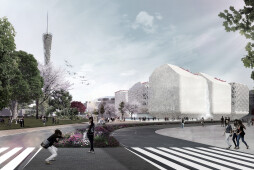
Guangzhou Museum

The architects von Gerkan, Marg and Partners (gmp) were awarded 1st prize for their competition entry for the new construction of the Guangzhou City Museum. At the same time, Nieto Sobejano Arquitectos (Madrid/Berlin) won the competition for the adjacent Science Museum which, together with the city’s new Art Museum (commissioned a year ago and being designed by Thomas Herzog Architects), will form the central cultural precinct of this third-largest Chinese city. These cultural buildings surround a large parkland area with squares, which lies to the south of the Canton Tower at the Pearl River.


The design for the Guangzhou Museum includes a reference to the historic Chigang Pagoda, which lies to the north of the building towards the Pearl River. The height of the northern end of the museum will be limited to 18 m, thus respecting the importance of the historic tower building, gradually rising towards the south to a total height of 40 m. This creates a roof terrace facing the Pagoda, which is accessible to the public via external staircases/ramps and, in addition to serving the museum, provides a view to the impressive skyline of the city to the north of the Pearl River.


The increasing height of the building volume can also be perceived inside the museum, which features a central hall with a range of terraced levels. The building, the shape of which has been developed within the urban design context, is characterized by the interaction between linear glazed openings for the entrance area, various commercial functions and restaurants/cafeterias, and opaque parts of the building for the exhibition areas. The calm, horizontal building volume defines the south-western boundary of Lingnan Square, which has been designed as a stage for public life in the city.


GUANGZHOU SCIENCE MUSEUM

The winning proposal by Nieto Sobejano, is based on an agrupation of nine volumes which are conceived as a flexible sequence of large scale “ceramic vases”. The functional program, with a total area of 80.000 m2 includes exhibition halls, temporary expositions, science and technology theaters, auditoriums, and a rooftop garden with views towards the city skyline and the Lignan Park. The architectural concept, born of a simple additive process, admits multiple variations of a limited number of elements generating a complex space out of a combinatorial system. The new Science Museum will be, together with the adjoining Guangzhou Museum and the Art Gallery, a landmark in the new urban axis, not only for its ambitious programme for the popularization of science, but also for its unusual spatial conception, which proposes a dialogue between the memory and historical tradition of the place and a state of the art technological and museographic approach.

Brand description

Nieto Sobejano Arquitectos was founded in 1985 by Fuensanta Nieto and Enrique Sobejano and has offices in Madrid and Berlin. Along with being widely published in international magazines and books, the firm’s work has been exhibited at the Biennale di Venezia in 2000, 2002, 2006, and 2012, at the Museum of Modern Art (MoMA), New York, in 2006, at the Kunsthaus in Graz

in 2008 and at the MAST Foundation in Bologna in 2014. They are the recipients of the 2007

National Prize for Conservation and Restoration of Cultural Heritage and the 2010 Nike Prize issued by the Bund Deutscher Architekten (BDA), as well as the Aga Khan Award for Architecture (2010), the Piranesi Prix de Rome (2011), the European Museum of the Year Award (2012), the Hannes Meyer Prize (2012), AIA Honorary Fellowship (2015), the Alvar Aalto Medal (2015) and Gold Medal of Merit in the Fine Arts in 2017. Their major works include the Madinat al-Zahra Museum, the Moritzburg Museum in Halle, the San Telmo Museum in San Sebastián, the Zaragoza Congress Centre, the Martin Chirino Foundation in Las Palmas, the Joanneum Museum extension in Graz, the Contemporary Art Centre in Córdoba, the Arvo Pärt Centre in Estonia and the Montblanc Haus in Hamburg. Nieto Sobejano Arquitectos is currently working on projects in several countries, among them, the extension of the Archaeologische Staatssammlung in Munich, the extension of the Museo Sorolla in Madrid, the Archive of the Avant-Garde in Dresden and the Carmen Thyssen Musem in Girona. Four monographs have been recently published on their work: "Nieto Sobejano. Memory and Invention" (Hatje Cantz Verlag, Ostfildern, Germany, 2013), "Fuensanta Nieto, Enrique Sobejano. Architetture" (Mondadori Electa Spa, Milano, Italy, 2014), "Nieto Sobejano Arquitectura 2004-2017" (TC Cuadernos 131/132, Valencia, Spain, 2017) and “Arvo Pärt Centre & Nieto Sobejano Arquitectos - A Common Denominator” (ArchiTangle, Berlin, 2020).

Enrique Sobejano has worked as an architect since graduating from the Universidad Politécnica de Madrid and the Graduate School of Architecture and Planning at Columbia University in New York in 1983. He is a professor at the Universität der Künste Berlin (UdK), where he holds the chair of Principles of Design. He has been a visiting critic and lecturer at various international universities worldwide. From 1986 to 1991 he was co-director of the architectural journal ARQUITECTURA, published by the Colegio Oficial de Arquitectos de Madrid. He chairs and participates in international conferences and juries and is a founding partner of Nieto Sobejano Arquitectos. He is a permanent member of the Akademie der Künste Berlin (AdK).

Fuensanta Nieto has worked as an architect since graduating from the Universidad Politécnica de Madrid and the Graduate School of Architecture and Planning at Columbia University in New York in 1983. She is a founding partner of Nieto Sobejano Arquitectos and a professor at the Universidad Europea de Madrid. Fuensanta Nieto lectures on architecture and participates in juries and symposia at various institutions around the world. From 1986 to 1991 she was codirector of the architectural journal ARQUITECTURA, published by the Colegio Oficial de Arquitectos de Madrid.

Products applied in Commercial , Residential
Share or Add Guangzhou Museum to your Collections