Archello Awards 2026 · Enter your projects before 30 September 2026

Cinema and architecture

An overview of projects, products and exclusive articles about cinema and architecture

Project • By WAM architectenCultural Centres

Cinema Pathé Leeuwarden

The new Pathé cinema is an eye-catcher in the center of Leeuwarden. The building references the traditional red-orange brick of the historical centre of Leeuwarden. The gracefully undulating facade, with its flowing soft shapes, relief masonry and columns like articulated legs, is an introduction to the illusory world of film. Architecture and cinema join hands evoking figurative associations: from a theatre curtain to a fantastic chimera, with the relief bricks as its scaly skin. Gerard van Beek Gerard van Beek   More

Product • By BegoluxCircular Ring Suspended

Circular Ring Suspended

Circular suspended aluminum luminaire with frosted diffuser, equipped with LED PCB. The layout of the LED’s makes a homogeneous and uniform light across the entire surface. Its design eases the access to its interior so the cleaning is simplified and more practical (without requiring specialized intervention). Supplied with all accessories for fixing, it can be customized according to the customer’s order, making it a unique and exclusive piece. Ideal for hotel, cinemas, bars and cultural centers. More

Project • By EYECinemas

EYE

EYE, the new film museum located on Amsterdam’s waterfront, will open its doors to the public on April 5, 2012. Starting on that day, visitors can watch films on the four screens, explore the exhibition area, the interactive basement, the museum store, and the restaurant and café. The new EYE Film Institute Netherlands is located on the northern side of the waterfront, directly across from Amsterdam’s Central Station. The Vienna based firm Delugan Meissl Associated Architects designed a striking complex that houses four screens, 640 seats and 1200 square meters of exhibition space. EYE is the only museum in the Netherlands that is exclusively dedicated to film and the moving image. EYE exhibits film as art, entertainment, cultural her... More

Project • By Arc2 architectenCinemas

Film Theatre Hilversum

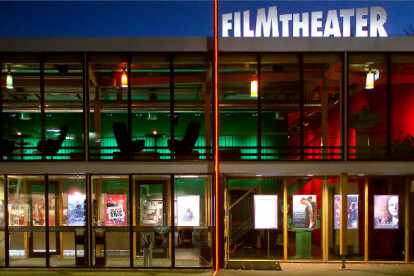
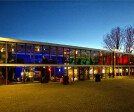
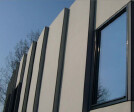
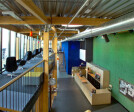
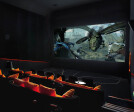
The Film Theatre consists of three cinemas. The glass frontage merges the foyer with the public space outside. The supporting frame is built in laminated wood, and organizes the foyer into a number of cosy niches where audience members can enjoy a drink before the film. The volume of the theatre nestles under a bend in a vehicle ramp. On this side its facade is opaque with a scaly cladding of fibre-cement sheeting. The challenge of the design was to make a building which would have a warm, festive feeling using limited resources. The timber construction contributes considerably to the atmosphere. Themed in red, green and blue respectively, the three auditoriums directly adjoin the foyer and are clearly visible from the square outside. The... More

Project • By OozeWorkshops

Tent Academy

TENT presents the 8th edition of the TENT Academy Awards, a national competition between young audiovisual artists. The selection consists of the best final exam videos, films, shorts, and animations from all the Dutch art academies in 2007. This year for the first time, the Awards include an exhibition in TENT, where the 2007 selection is presented alongside previous editions of the competition. The expression and materialisation of spaces of projection and visualisation was the underlying theme in this installation. Two giant screen units for the communal projections (the 2007 competition films) and four small TV units for the archive of the preceding year were constructed. Together the elements form a landscape of trapezoidal projection... More

Project • By Rojkind ArquitectosCinemas

Cineteca Nacional del Siglo XXI

The National Council for Culture and the Arts (CONACULTA) has announced that the "Cineteca Nacional del Siglo XXI" project has been awarded to Rojkind Arquitectos. "To intervene and expand the National Film Archive involves understanding a substantial change in film, as suggested in the term "moving pictures".Today, images move not only on a screen, the screens move with us:they go where we go, and the movies, have gone from being a gathering space for the masses, to also reaching us wherever we might be. The new National Film Archive and Film Institute must understand this condition, both to ensure and protect the wealth of our country's moving pictures as well as those of the rest of the world and to make them accessible, in all t... More

Project • By VONSUNGTheaters

Pushkinsky Cinema

The Pushkinsky Cinema was built to display the most important cinematic productions in Russia. Built at Pushkin Square, it became the landmark of the country's film festivals, a palace for the Moscow International Film Festivals (MIFF) for movie protagonists and moviegoers from Moscow and abroad. Our proposal for the cinema's architectural shape is dictated by three main requirements: visual contact with the Pushkin Square has to be maintained, the Pushkinsky Cinema's original architects’ vision is displayed in its entirety and the building has to adapt to the historical surrounding amid the historic, busiest square of Moscow. The measure of performance is relative to each project’s constraints and aspirations. The Pushkinsky Jewel vis... More

Project • By 24d-studioCinemas

Fog Cinema


Many masters of Russian cinema, from the introduction of Lumière Brothers to Russia, then Vertov, Eisenstien, Tarkovsky and Sokurov to name a few, have provided us with unimaginable vision of how our world can be seen from a different perspective. Through their evolving art of cinema, not only do its visuals stimulate us but furthermore, our subconscious creates a deeper imagination to the contents we literally experience. Cinema world allows us to explore the unknown territory that cannot be experienced in the reality. When we enter the realm of the black box and see the events that unfold in front of us caused by the bright projection, and in the most magical moments, we feel like we are participating in those fictional events. The... More

Project • By Symbiosis Designs Ltd.Universities

Red Sea Institute of Cinematic Arts (RSICA)

'In creating film one has to know how to take flight with light and understand the nature of its nature; to become a shadow and converse with ambiguity touching it but never gripping it; to understand the concept of contrasting harmony and how opposites bow to each other and sometimes dance in no less capacity than utterly consumed and locked souls; to travel with raw sound, whispers and sometimes silence itself and meet enchantment yet sense the most silent scream to be the loudest; to adopt the gentle breeze and learn a lesson or two on the prolific powers of gentle sways; to know how to become absolutely drunk and utterly intoxicated on a good conversation; to be able to ride chaos and make good sense of it; to use ice cold that is actua... More

Project • By Robert Majkut DesignCinemas

cinema for the biggest Asian cinema group

Orange Cinemas interiors consist of Piano Bar zone, private VIP-rooms, Cigar Club, and three luxurious cameral auditoriums: Black Room, Orange Garden and Pink Sky. Lobby is a unique cameral club space with the collection of the latest works of art. Robert Majkut, with his great experience, has created unique cinema interiors for many years. Also this project has a unique character. The designer tells a story about moving, turning forms, movement, sun, impressions, and illusion of the cinema. All these elements are expressed by colours, textures, and light. The space is created thanks to variable light of big screens, sounds from Piano Bar, and the intense play of colours. Logo, inspired by manually painted Chinese symbols, was the b... More

Project • By Duende StudioCinemas

Heng Shan cinema in Shanghai

he Naço agency in Shanghai has carried out the renovation of the mythical Heng Shan cinema, the first "new China" cinema built in 1951. The renovation of this Art Deco cinematic liner was a question of completely rethinking the traffic surrounding the cinema as well as the appalling façade. The façade is now adorned with vertical GFC lines (Glass Fiber Concrete) which have refined the building and reduced its monumental and heavy appearance, whilst a black concrete strip decoratively brings it all together and separates these lines from the ground. The enclosed garden has been completely opened out and rethought to create a new welcoming open garden space in front of the cinema in order to connect naturally with the park situated rig... More