




Amager Bakke—widely known as CopenHill—stands as a defining landmark on Copenhagen’s industrial waterfront. Conceived by Bjarke Ingels Group, the project reimagines the conventional waste-to-energy plant as a piece of hybrid urban infrastructure, combining energy production with public recreation and environmental education.
Rather than treating the plant as an isolated industrial object, the design integrates it into the life of the city, transforming its vast roof into a year-round ski slope and public park. This bold intervention expands the area’s recreational offer while strengthening the building’s connection to its surroundings.
Since opening, CopenHill has evolved into an extreme sports hub, attracting visitors for activities as diverse as skiing, climbing, cable wakeboarding, and go-kart racing. Replacing a 50-year-old incineration facility, the plant not only improves waste-to-energy efficiency but also reframes infrastructure as a civic asset—one that is economically viable, environmentally responsible, and socially engaging.


Energy infrastructure with a public agenda
The core program of CopenHill is a waste-to-energy (WTE) facility capable of processing 440,000 tons of waste annually, generating electricity and district heating for approximately 150,000 homes. Operated by Amager Resource Center (ARC), the plant employs advanced combustion and filtration technologies to minimize environmental impact—placing it among the cleanest WTE plants globally. Its performance supports Copenhagen’s target of becoming carbon neutral by 2025.
Rather than concealing its industrial nature, the architecture places the plant's inner workings on view. Visitors ascending to the rooftop via glass elevator are given clear sightlines into the furnaces and machinery operating below, turning public education into a built experience.

Material optimization
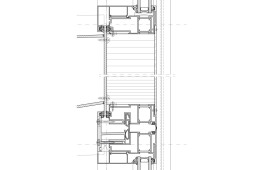
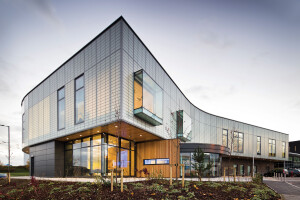
The architectural envelope—composed of 3.3-meter-wide extruded aluminum bricks—emphasizes performance, durability, and material circularity. Aluminum was selected for its high recyclability, long service life, and corrosion resistance. Its overlapping, brick-like form improves water shedding, requires no external coatings, and can be dismantled or recycled at the end of its life cycle.
Integrated glazing bands ensure daylight penetration deep into the facility and provide natural illumination for administrative spaces. The structure is built on a steel and concrete frame, typical for industrial buildings of this scale, but configured to support a complex public program layered above its utility core.
Landscape as insulation and interface
The 10,000 square meter green roof, designed by SLA, functions as an active microclimate regulator, improving air quality, absorbing rainwater, and reducing heat island effects. Its terrain includes over 300 trees and 7,000 shrubs, selected for biodiversity, wind resilience, and limited soil depth.
This natural layer doubles as recreational terrain—a 490-meter hiking and running trail, providing Copenhageners access to the city’s highest vantage point without ever leaving the urban grid.


Technical innovation
The most visible layer of the project is the 9,000 square meter artificial ski slope, finished with Neveplast NP30 FREESKI—a modular, polyethylene surface requiring no snow, refrigeration, or water. This system allows year-round skiing and freestyle training while maintaining a low environmental footprint.
The slope includes carpet lifts, a platter lift, and a slalom course, catering to various skill levels. The materials support circular reuse, with tiles replaceable and recyclable at the end of life. At the slope’s base, a 600 square meter après-ski bar connects directly with public circulation and social activity, reinforcing the site’s role as a civic amenity.


