


Located in the northeastern part of Sherbrooke, Quebec, Habitation Léon-Deschamps encapsulates the result of sustainable, quality construction and energy-efficiency. The project team achieved Phius design certification (as of October 2026, it is the largest design-certified building in Canada) and ZCB-design certification (zero carbon design).
As this is a new building in Quebec, the project team needed to follow the 2015 National Building Code (NBC) with Quebec’s amendments. Ventilation regulations enforced within the building code require designers to abide by the ANSI/ASHRAE 62.1 requirement, “Ventilation for Acceptable Indoor Air Quality”, to meet the outdoor air ventilation standard—which is a common regulatory requirement. However, Raphael Boisjoly, CPHC of akonovia engineering had to also comply with Phius and Novoclimat ventilation requirements, much stricter energy and building requirements than the standard building code in regard to airtight characteristics and energy-efficiency.

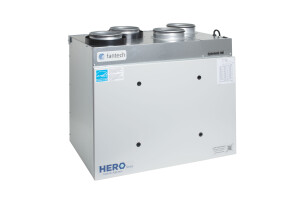
For example, Phius requires balanced ventilation throughout the building and specific high efficiency markers for ventilation equipment. All HRVs can satisfy the first requirement, but these HRVs also needed to be able to surpass 75% Sensible Recovery Efficiency (SRE). To satisfy this requirement, each individual unit received balanced ventilation systems known as Fantech HERO 150H-EC HRVs. Boisjoly explained that Phius accepts SRE at the actual airflow of the building versus the manufacturer reported SRE, thus complying with the requirement and easily surpassing the SRE requirement. Boisjoly explained to us how this was possible, “Phius allows efficiency extrapolation based on the unit's actual operating airflow. In this project, most of the 3½-room unit’s required a constant ventilation rate of only 55 CFM, which resulted in higher SRE values.” He also told us about ventilation restraints within Quebec in new high-performance buildings and the decision to use Fantech HRVs. “Novoclimat requires [HRVs/ERVs] to have recirculation defrost. When going down the Novoclimat list, we found the Fantech HERO HRV was the best option under these conditions.”

Built with environmental impact in mind, the project team made considerable efforts to reduce its carbon footprint whenever possible—such as, sourcing local material to decrease distance traveled for material transportation and recycling construction waste. This, while being a hurdle to some, did not limit the project team’s timeline, as design to construction required less than 3 years—a relatively typical timeframe for a mid-rise, high-performance multifamily building. Alongside sustainability, energy-efficiency and resiliency were top priorities. The building features an airtight envelope with ROCKWOOL Cavityrock insulation, high-efficiency heat pumps, high-performance windows, balanced recovery ventilation, and glazing considerations that will help tenants now and in the future save close to 90% on energy annually.
When asked what the residents think about living in a building that was prioritized for energy savings and comfort, Brigitte Bouliane, senior project manager at Office municipal d’habitation de Sherbrooke (OMHS) spoke about the impact to tenants and the owner (Le Parallèle de l’Habitation Sociale is a non profit organization owned by OMHS)

“Our tenants are grateful to have access to high-quality housing that is safe for their health and affordable, both in terms of heating costs and overall rent.” She continued, “Le Parallèle de l’Habitation Sociale (the owner) is also extremely proud to be able to improve the living conditions of its tenants and greatly appreciates the reduction in energy costs for common areas.”
Architectural design was handled by Équipe A architecture with mechanical and electrical design by Akonovia engineering. Construction was carried out by HUDL. The customer is Le Parallèle de l’Habitation Sociale.


