


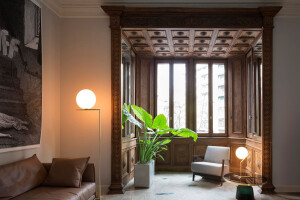


Inspired by the refined lifestyle of Southern Song Dynasty literati, this residential project by Z+H Interior Design reinterprets classical Chinese aesthetics into a contemporary Oriental vacation experience. Drawing from Liu Songnian’s Four Seasons Landscape paintings, the design concept evokes a poetic and serene atmosphere, blending cultural heritage with modern sophistication. The spatial layout follows a central axis reminiscent of Suzhou’s Master of the Nets Garden, guiding visitors through a journey of architectural elegance. A grand colonnade runs through the villa, where each beam and column reflects meticulous craftsmanship and evokes the ambiance of Jiangnan literati spaces. Framed landscape views, monochromatic contrasts, and shifting light create a dust-free environment of subtle elegance and nobility.

On the first floor, the living room features Jiangnan-style lattice windows in wood and stone, forming a symmetrical yet dynamic space. Furnished with the white Dorian sofa set, it embodies understated luxury and a harmonious blend of Eastern and Western influences, reminiscent of The Travels of Marco Polo. The minimalist design, inspired by Song Dynasty aesthetics, is both pure and richly textured, showcasing the seasonal lifestyle of Southern Song literati. The master bedroom offers a tranquil retreat, combining a long corridor with refined lighting, a classical canopy bed, and a serene modern floor lamp to create a graceful and sophisticated sleeping space. The secondary bedroom, accessed through a tall wooden lattice doorway, opens to a forest landscape through large patterned windows, offering a peaceful and high-quality resting environment.

The interior woodwork was executed by master artisans with over 20 years of experience in Ming-style furniture. Custom wooden wall panels were crafted using the traditional Long-Feng (Dragon-Phoenix) mortise-and-tenon with cross-band technique, a hallmark of Suzhou craftsmanship. This method enhances structural integrity while preserving the handmade character of each element. When a single plank is not wide enough, two or more are joined using a long mortise shaped like an ingot and a grooved counterpart, forming the Dragon-Phoenix joint. Trapezoidal wooden strips, called cross bands, are inserted across the back for reinforcement, locking tightly and ensuring stability while leaving visible traces of artisanal mastery.


