Industrial heritage

An overview of projects, products and exclusive articles about industrial heritage

Project • By TBA Architecture • Care Homes

Réhabilitation d’un entrepôt en maison médicale

In Saint-Ouen-sur-Seine, the project transforms a townhouse and a former warehouse into a 496 sqm multidisciplinary medical center. The intervention builds upon the specific qualities of the two existing structures, adapting them to a new healthcare program. Facing the street, the townhouse accommodates the entrance and the first medical practices. Its façade is reworked in terracotta brick, establishing a dialogue with the surrounding urban fabric. At the rear of the plot, the former warehouse is restructured and extended vertically to accommodate, among other functions, physiotherapy and balneotherapy spaces. TBA Architecture The transformation preserves the reading of the warehouse as a generous open volume. A new glazed ro... More

Project • By MENDONÇA CARRÃO - ATELIER • Offices

Sumol Compal Headquarters

The historic headquarters of Sumol Compal in Lisbon—Portugal’s leading non-alcoholic beverage corporation and official regional producer for global brands like Pepsi, Lipton, 7UP, Guaraná Antarctica, and Gatorade—underwent a deep modernization and corporate retrofit designed by MC-A. André Castro Leitão André Castro Leitão André Castro Leitão André Castro Leitão André Castro Leitão With industrial origins dating back to 1971, when it operated as a bottling plant, the project transformed its 3,100 m² space into a smart, dynamic work ecosystem centered on human well-being. André Castro Leitão Andr... More

Project • By Eklekt Atelier • Apartments

Velvet Concrete

Velvet Concrete is a residential interior located in Zabłocie — a post-industrial district of Kraków undergoing rapid transformation. The project reinterprets this industrial heritage through material logic and spatial clarity, rather than through obvious aesthetic references. ANNA GRUSZKOWSKA ANNA GRUSZKOWSKA ANNA GRUSZKOWSKA The design is based on a continuous spatial flow, where boundaries between zones are defined only by transparent architectural elements: full-height glass partitions, mirrored arcs and subtle shifts in textures. This strategy preserves openness and allows natural and artificial light to act as shaping devices — modelling depth, direction and hierarchy. Materiality provides the main... More

Project • By RAMÓN ESTEVE ESTUDIO • Community Centres

Rodes Industrial Park

The project is based on the idea of reconnecting Alcoy with its industrial past, its Art Nouveau architecture and its natural environment. The project highlights the importance of the architectural heritage from a contemporary, modern perspective, as it reinterprets the complex’ architecture in a way that promotes the new economic models that the city needs. Alfonso Calza The voids are arranged and transformed into a single space that generates a suggestive atmosphere that recalls the history of industrial settings and the wealth that they provide the city with. Alfonso Calza Alcoy cannot forget either the great cultural relevance of music in the city. As tribute, the park is organized as if it were a pentagram. Tree veget... More

News • News • 31 Oct 2024

Urban plan for Oostenburg in Amsterdam’s city center combines industrial heritage with urban density
The artificial island of Oostenburg is the final large-scale development in Amsterdam’s city center. This area’s impressive urban plan combines its industrial heritage with a dynamic  approach to urban density, flexible city blocks, and proactive community growth. Amsterdam-based Studioninedots collaborated on the urban plan’s development.  Oostenburg’s’s first residents arrived at the end of 2020; it’s anticipated that the last residents and entrepreneurs will arrive in 2025, completing the new live-work district. Sebastian van Damme Sebastian van Damme   Oostenburg: A potted history The Eastern Islands of Kattenburg, Wittenburg, and Oostenburg in Amsterdam were forme... More

News • News • 20 Mar 2024

New infill apartment building in Prague reflects an industrial heritage
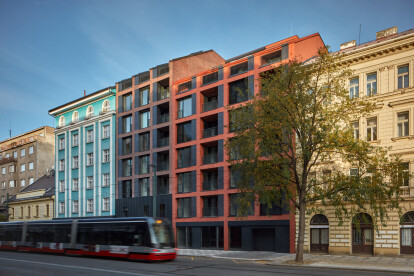
Iconik is a residential apartment building in the Karlín neighborhood of Prague. Designed by Prague-based architectural office edit!, the building occupies one of the district’s last remaining empty sites, a result of the devastating floods that occurred in August 2002. Today, this hip area of the Czech capital has undergone major architectural and social transformation. A one-time industrial district, the Iconik building’s design reflects Karlín’s industrial heritage and adds to the area’s ongoing revitalization. BoysPlayNice BoysPlayNice A project for the Karlín Group, its founder Serge Borenstein had previously invited renowned Catalan architect Ricardo Bofill and a group of... More

News • News • 17 May 2023

New offices at TechnoCampus Berlin pay tribute to the surrounding industrial heritage with quality details and craftsmanship

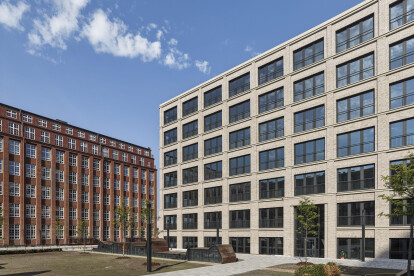
Located at the Technocampus Berlin, Tchoban Voss Architekten’s latest addition of two office buildings with an underground car park balances an ensemble of historical constructions that surround by paying tribute to details, quality of craftsmanship, and a generous sequence of rooms and spaces.  Stefan Mueller The project is located on the approximately 51,300 square meter site at Siemensdamm 59-62 and forms the eastern boundary of Siemensstadt. The adjacent Wernerwerk XV, under architectural monument protection, is located in the building’s immediate vicinity. Initially constructed in 1924-1925, the Wernerwerk by Hans C. Herlein is a former transmission system factory that was redesigned over several construction... More

Project • By Liong Lie Architects • Art Galleries

Taets Art and Event Park

AmmunitionA former ammunition factory, part of the industrial heritage of the Zaanse Hembrug area, is transformed into an art gallery and conference centre. Taets Art Gallery is a contemporary, international orientated gallery that frequently organizes exhibitions and events. With the utmost care for the monumental building, Liong Lie architects transformed it into a modern centre. Caption Modern meeting roomsThe rooms for presentations and meetings can accommodate up to 500 persons and are provided with LCD-displays, comfortable chairs and a remote controlled air conditioner. Caption Caption TransformationThe existing building, dating from 1880, has a metal truss structure. It has an outer leaf of brickwork, wooden floors... More

News • News • 30 Nov 2022

Sterck’s new showroom revives the glory of the industrial heritage of Aalst, Belgium
Formerly a weaving mill repurposed into a Tupperware plastic factory and recently transformed into a new showroom for designer furniture by Sterck NV by Objekt Architecten, the project sits in the historic industrial town of Aalst, Belgium.  Ypsilon Business Photography Marked by traditional brick masonry and has three symmetrical bays, restoration of the historically significant building involved preserving the industrial essence in the design process. Ypsilon Business Photography The striking façade, characterized by brick embellishments, is restored completely, utilising a unique cleaning procedure, bringing value to the site and the city. Openings were made on the rhythm of the existing rectangular planes... More

News • News • 16 Jun 2022

Site Verrier de Meisenthal defines a contemporary institutional identity in dialogue with industrial heritage
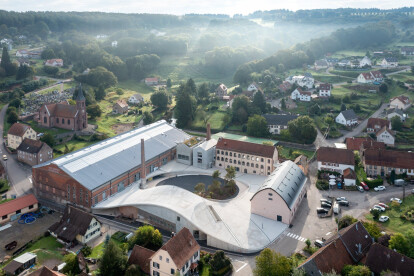
Located in a historic glass factory from the 18th century, the Site Verrier de Meisenthal is a publicly funded active cultural centre containing three independent yet interrelated institution buildings. This latest intervention by FREAKS Architecture in collaboration with SO-IL unifies these programs to define a contemporary institutional identity in dialogue with industrial heritage. Iwan Baan The three buildings contained within the centre are Glass Museum(Musée du Verre et du cristal), the Centre International d’Art Verrier or CIAV, which is an international glass art center where traditional craftsmanship meets contemporary practices, and the Cadhame (Halle verrière), a multidisciplinary cultural space hosting... More

News • News • 24 Sep 2021

MKM Museum extension by Herzog & de Meuron blends with existing Küppersmühle grain mill
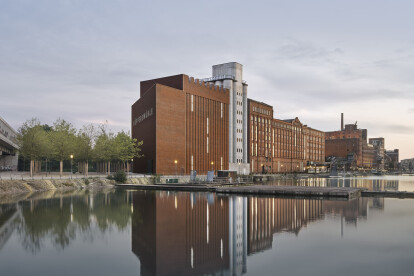
The MKM Museum extension has a long history in the making. The grain mill, originally from 1860 with the current buildings dating back to 1908, turned into a museum in 1999. The museum houses the Ströher Collection, which is one of most extensive private collections of German post-war art to date. Simon Menges Herzog & de Meuron were involved from the start and designed an extension that was supposed to be erected on top of the silo towers in 2008. Faulty work by the steel-working company and subsequent bankruptcy resulted in the project being abandoned. Simon Menges In 2013 with the Ströher family as new clients, Herzog & de Meuron set aside the original idea of an illuminated cube balanced on the silo towers... More

News • News • 5 May 2021

For the 500 new houses of Strijp R Bedaux de Brouwer Architecten was inspired by the location’s industrial history

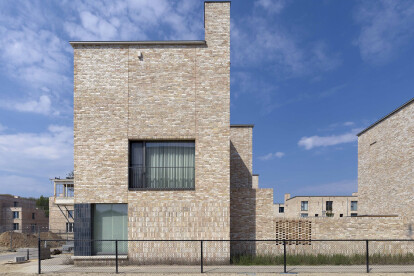
Strijp R is located in Eindhoven’s former Phillips factory site that is slowly being transformed into an industrial style city neighborhood. The spatial qualities of the industrial heritages were translated by Bedaux de Brouwer Architecten into housing with clear volumes, plentiful natural daylight and spacious interiors. Michel Kievits The 500 new houses refer back to the old factories with architectural details like cornices, masonry, concrete elements and tile surfaces. Masonry walls demarcate the line between public and private. Michel Kievits The Canne special antique bricks were baked in a traditional ring furnace by Vogelensangh brick factory in Deest. The variety in brick bonds and patterns soften the architecture.... More

Project • By lamatilde • Factories

EDIT – A taste for sharing

An acronym for “Eat Drink Innovate Together”, EDIT is an original concept lamatilde has brought to the food and beverage field, in collaboration with business accelerator The Doers. It is a unique example, on international level, of contamination between American culinary incubators, Italian cuisine’s love for innovation and craft breweries’ experimental potential.Within its 2,400 square meters (almost 26,000 square feet), EDIT includes a bakery, a pub, a brewery, a cocktail bar, a restaurant and a kitchen area: a mix that contributes to a dynamic and flexible space, able to cater to both professionals – who can rent the equipment they need – and end clients, with a complete “menu” of options... More

Project • By MUA - Architecture & Placemaking • Hotels

Fabrika Tbilisi

The Site Fabrika is located in a historic neighborhood which has been a central but less popular part of the city. Before the revitalization of the place, the building of the sewing factory that was operating during the soviet time was abandoned for the decades with no use to the neighborhood and society. The district was also unpopular as the destination for travelers or locals. The starting point was to analyze the urban context where the project could bring multiple benefits for the area: increase its publicity and influence the economic and social life of the neighborhood. Creation of a new hotspot and thus, improving the attractiveness of the area was one of the main objectives. Nakanimamasakhlisi Photo Lab Fabrika has become un... More