Not every project starts with a standard product.
For more than three decades, Buschfeld has developed lighting infrastructure for architecture, museums, heritage buildings and custom interiors. Alongside the standard portfolio, many projects require adaptations that respond directly to a space, an object or a specific design idea.
These projects often begin with a conversation. A client arrives with an idea, a challenge or a vision for a space. Rather than searching for a predefined product, we work together to develop the right solution. Sometimes this means a small adaptation. Sometimes it leads to a new component, geometry or luminaire created specifically for the project.
The result may be a custom finish, a modified luminaire, a curved track geometry, a freestanding structure or an entirely new component. Some adaptations remain unique to a single project. Others become part of the Buschfeld portfolio and continue their life in new applications.
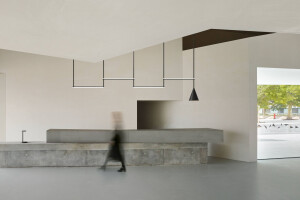
Bespoke Solutions can take many forms. Track systems are produced in custom colours and finishes, from project-specific powder coatings to brass and other material variations. Geometries can follow architectural conditions, create sweeping freeform installations or support lighting concepts that extend beyond linear layouts. Existing systems can be adapted to integrate luminaires from external manufacturers or to accommodate unique lighting requirements.
The scale ranges from subtle modifications to fully developed custom products. Examples include the freestanding lighting steles and the custom X01 wall luminaire developed for the Copenhagen Museum, miniature luminaires created for St. Ulrich und Afra in Augsburg, as well as project-specific infrastructures for lighting clusters, artistic installations and exhibition concepts.
What connects all of these projects is not a particular shape or product category, but a shared approach. Buschfeld sees lighting infrastructure as a flexible architectural tool rather than a fixed object. The system provides the foundation. The project defines the outcome.
Because every bespoke solution starts from a real architectural requirement, each one becomes part of an ongoing process of refinement, adaptation and learning. Sometimes a special solution remains unique. Sometimes it becomes the beginning of a new standard.