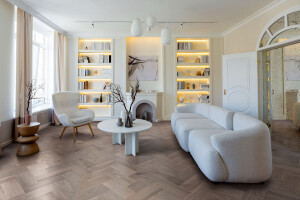
Here at our family-run mill in Brattleboro, Vermont, working with eastern white pine is like cheering for the Red Sox. They’re both New England favorites with deep roots and a long history underfoot. For more than 250 years, eastern white pine has been the flooring of choice in this region.
Eastern white pine’s humble charm is perfect for a casual home. The species’ slow growth results in a tight, smooth, inconspicuous grain pattern with occasional large knots. Its color typically falls somewhere between pale yellowish tan to light reddish-brown. These attributes provide an earthy quality to any space it inhabits.
Eastern white pine’s versatility allows it to blend harmoniously with both traditional and contemporary motifs. The patina it develops over time adds to its allure, providing a soft and welcoming sense of comfort.
At Vermont Plank Flooring, we work with small, private New England landowners who supply us with wood selectively cut from trees that have reached full maturity. This allows us to produce eastern white pine flooring in the widest planks available—from 10 to 15 inches in width—and up to 16 feet in length, effectively matching the impressive boards milled from the old-growth trees harvested in the pre-Revolutionary era. Nobody else comes close.
With fewer seams, wide planks create a more striking design aesthetic and a sense of luxury and expanse. For many wood species, the wider the boards, the more prominent those seams can become, as normal seasonal expansion and contraction aren’t distributed across several boards. But eastern white pine is surprisingly stable dimensionally when dry, thereby minimizing the prospect of yawning gaps, even with planks a foot or more in width. Seamless, indeed!
If you are looking for flooring that is an impenetrable fortress, look to another species like white oak, hickory, or walnut. Eastern white pine is technically a softwood, so it will ding and dent over time. But we like to think of those accumulated imperfections as a patina—character enhancements that add to the charm and appeal. Over time, extensive foot traffic will prompt eastern white pine flooring to harden as the wood’s fibers compress, resulting in a foot-worn floor that will last for hundreds of years, as it has in the pre-Revolutionary War homes of Bunker Hill, Lexington, and Concord.
Eastern white pine will provide an unpretentious quality to your home—simple, but simultaneously beautiful. Its subtle grain pattern is juxtaposed with occasional large knots, offering a playful variability. Its color, varying from creamy tan sapwood to ochre-tinged light brown heartwood, holds finishes exceptionally well which provides opportunities to create a perfect balance between eastern white pine’s natural welcoming warmth and the style and character of the other elements of your home’s interior.
Its gentle luxuriousness will add coziness to your living room, dining room, or bedroom. And in more highly trafficked kitchens and hallways, its evolving character will provide a sense of history to your home. For basements, bathrooms, or potentially damp locations, consider our engineered flooring.
Early settlers found the species in great supply in the nearby forests of New England and quickly learned that it was relatively easy to cut and saw. As the tallest pines in North America, and with impressive diameters, the trees were used for ship masts. They also produced long and unusually wide boards that made for easy and quick flooring installation. Those wide planks are a hallmark feature of homes in historic districts throughout New England.