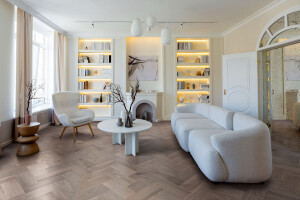
Birch’s golden sapwood, often juxtaposed with its dark red or brown heartwood and dappled with a gently woven grain pattern make it a sophisticated and desirable choice for hardwood flooring. Stir birch’s surprising durability into the mix, and the result is an alluring option that will brighten and beautify any home.
As a hardwood flooring material, birch’s sunny yet sturdy disposition has prompted a growing popularity and stature. The light and dark colors coinciding within many planks provide a unique design statement that is equally comfortable in both traditional and contemporary settings.
Birch lives life in the fast lane. It is a pioneer species, meaning it is often the first to sprout in a fallow or recently cleared field. It grows quickly and lives a relatively short life compared to other species. As a result, most manufacturers harvest birch earlier than is ideal to allow for the next generation to take root. That speedy cycle means greater profits and skinny board widths.
But at Vermont Plank Flooring, we work exclusively with FSC-certified woodlot owners who grow birches sustainably and with patience. The fully mature trees they harvest allow us to mill the widest and longest boards in the business, up to a remarkable 12 inches wide and up to 12 feet long.
Boards of those dimensions result in a relatively unbroken plain that showcases the beauty of the wood rather than the seams between them.
All wood floors are susceptible to some scuffs, scratches, and dings, though some species are more resistant than others. Birch’s papery bark might suggest a thin skin, but beneath that soft exterior is a surprisingly durable wood. In fact, birch’s hardness is almost identical to that of red oak, and significantly greater than both walnut and cherry. It is a heavy, strong wood, with good crushing and shock resistance. That means if you’ve got kids, pets, and regularly throw all-night dance parties, or if you just want to feel confident that your flooring will stand up to regular wear, birch’s durability will let you rest easy.
A quality finish will add an additional layer of security. Vermont Plank Flooring’s custom finish shop can work with you to determine the best finish for both your durability requirements and aesthetic leanings.
Birch’s color contrasts are a defining component of its allure. Its creamy white or golden sapwood, combined with its typically brown or dark reddish heartwood, makes for a striking one-two punch. Layer in a primarily straight grain pattern punctuated by occasional curls, waves, and cathedral markings, and you’ve got a knockout that will enliven any room.
Vermont Plank Flooring offers two birch grades, select and character. The select grade highlights planks with cleaner, crisper, more consistent coloring, texture, and grain patterns, whereas character grade celebrates birch’s playful color and grain contrasts and showcases occasional knots.
Regardless of the grade, many customers opt for a clear finish that allows birch’s innate beauty and sunny glow to shine through.
Just as the birch tree’s white to light grey bark punctuates the forest with stripes of brightness, so too will the wood in the context of your home. Birch’s glimmering luminosity will make living, dining, and family rooms more delightful and contribute an allure to more private spaces in your home. For well-trodden locations, such as the kitchen, entryways, and staircases, birch will fend off most wear and tear; though, as with most hardwood flooring, some of life’s activities will undoubtedly leave their story behind.
Birch, however, is not particularly impervious to moisture and water, so its use in locations such as bathrooms, basements, or anywhere below grade is not recommended in its solid hardwood form. For moisture-prone situations, Vermont Plank Flooring recommends instead our wide plank engineered birch flooring, which is far more stable and resistant to buckling and deterioration.
The birch tree’s smooth bark makes it easy to spot in the northern forests that stretch from New England to the Great Lake states. The native inhabitants of that region knew well the usefulness of the tree. They stripped the flexible, papery bark from downed trees and used it to construct waterproof canoes, wigwams, and bowls. In more recent years, the tree has also provided extracts for flavorings, glues, and oils. And its natural aural resonance makes it sought after for everything from speaker cabinets to drumkits to guitars.
Birch’s utilitarian properties have made it one of the most sought-after woods on the market. It is the most widely used wood for the veneers used to make doors, paneling, and furniture. That strong and dimensionally stable veneer is also the primary material for most plywood. But its utility should not overshadow its striking beauty.