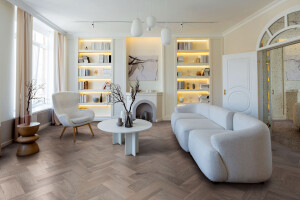
Here in Vermont, maple trees are serious business. Our sugar maples produce the finest (and sweetest) pure maple syrup on the planet, and we’re proud of it. So much so that the maple has been deemed the official state tree of Vermont. But aside from making our pancakes taste great, our maples are also the source of stunning hardwood flooring.
Maple’s predominantly straight, subtle grain and rich amber hue brighten and enliven any space, providing a crisp, airy feel that leans toward contemporary design aesthetics. Paired with its formidable durability, maple will brighten and enrich your home with natural elegance for several generations to come.
With their vibrant burnt orange and fiery red leaves, maple trees anchor the palette of colors that bursts forth on Vermont’s hillsides each autumn. Similarly, when cut and sawn, maple’s clean grain and resonant tawny tone illuminate and animates any room. Maple is probably not the best option if you are looking for a dramatic grain and a variety of visual textures in your flooring (if you are, consider instead walnut or white oak). But, if you want a radiant, harmonious look, maple is on the mark.
The sugar maples we mill at Vermont Plank Flooring typically mature at between 60 and 100 feet in height, and with trunks up to four feet in diameter. And because the woodlots they grow in are managed for sustainability, each maple is given space to spread its limbs. Without competition for sunlight, they grow straight and strong, providing us with planks in widths of up to twelve inches, and lengths of up to twelve feet. Those wide and long planks create a luxuriousness and openness that will make any room feel more expansive.
Maple is extremely durable. Just consider the maple bowling pin at the receiving end of the bowling ball. Maple sits near the top of the chart for domestic hardwoods when it comes to hardness, ranked only behind hickory. That means it is less prone to dents than most species. Maple can show scratches, however, which makes the choice of a quality protective finish critical. The good news is that maple’s relative porosity allows it to accept those stains and finish well. Our custom finish department can help you choose the best option to keep your maple flooring looking brand new.
Maple’s preeminent buttery flaxen coloration and subtle uniform grain create a bright, clean look that has made it a perennial flooring favorite. That popularity has flourished in recent years with the growing interest in Scandinavian and mid-century modern-inspired interior design, as maple accentuates those spacious, elegantly minimalist styles. Maple optimizes natural light, and with a variety of stain options available—from bone-white to rich brown—, it has the capability of providing a lively backdrop for any interior theme, from formal to rustic.
Maple’s durability and hardness make it well suited for active areas of your home, including the living room, family room, stairways, and hallways. Pet claws and kitchen chairs slide this way and may leave some scratches, but the proper finish and well-placed rugs will help minimize that concern. A quality finish will also make it easy to clean and maintain your maple floors.
For rooms with the potential for moisture and wetness, including bathrooms, basements, and entryways, we recommend moisture-resistant engineered flooring. Engineered maple also offers much greater stability than solid maple, which has a propensity to expand and contract with climatic fluctuations.
Maple is a tonewood, which means that it carries sound waves well and produces a bright resonance. As a result, it is used in the making of a variety of musical instruments, including violins, bassoons, and drums. In the realm of wood products, in addition to hardwood flooring, maple is a favorite of woodworkers and furniture-makers.