
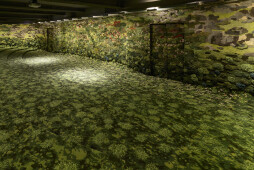
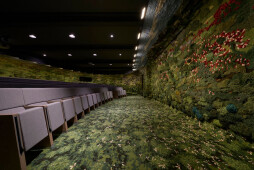

MVRDV’s transformation of JUT Foundation’s new 240m2 lecture hall takes into consideration that although it is a functional space for talks and events, it is also a public installation due to the carpeted landscape that makes it more inviting, comfortable and attractive to users. So yes it a form of public architecture but one that takes a more unconventional design inspired by the natural landscape. The hall will be used by a variety of audiences and connected to the exhibition programme in the gallery of JUT Foundation located on the ground floor. It is a new typology for a lecture hall with its own unique work of art; a single, large-scale textile artwork by Argentinian artist, Alexandra Kehayoglou. Alexandra was perfect for this project because there is such a commitment she has to craftsmanship and these pieces she makes are the result of a laborious hand-tufting process to fabricate wool carpets and rugs that mimic natural textures like moss, water, trees, and pastures. The carpets can transform an entire room (like we see here in the lecture hall) echoing a green landscape.
Jut Group Lecture Hall
Jut Interiors

Applied products


Project credits
Project data
- Location
- Taipei, Taiwan
- Project Year
- 2017
- Category
- Auditoriums
Cultural Centres - Stories By
- MVRDV
Alexandra Kehayoglou
LAMM
Featured sustainable Auditoriums and Cultural Centres


360 Panorama

JUT Foundation’s new lecture hall is a form of public architecture taking on an unconventional design inspired by the natural landscape that is inviting, comfortable and attractive to users. This new typology for a lecture hall features a unique work of art; being a single, large scale textile artwork by Argentinian artist Alexandra Kehayoglou entitled 360 ° Panorama. The pieces result from a laborious hand-tufting process to fabricate wool carpets and rugs that mimics natural textiles like moss water, trees and pastures. The result is an immersive landscape, offering a silent cave to stop and experience.
More from the Artist:
JUT Foundation’s new lecture hall is a form of public architecture taking on an unconventional design inspired by the natural landscape that is inviting, comfortable and attractive to users. This new typology for a lecture hall features a unique work of art; being a single, large scale textile artwork by Argentinian artist Alexandra Kehayoglou entitled 360 ° Panorama. The pieces result from a laborious hand-tufting process to fabricate wool carpets and rugs that mimics natural textiles like moss water, trees and pastures. The result is an immersive landscape, offering a silent cave to stop and experience. More from the Manufacturer:
360 ° Panorama is a site specific textile work that covers the whole of the JUT lecture HALL in Taipei, Taiwan. This work celebrates and immersive landscape, offering a silent cave where to stop and experience.
This project is the biggest project done by myself and my studio so far, representing a big challenge in terms of stretching out my work to a new dimension and limits within the fusion world of arts and architecture.
My work explores the forensic understanding of how the landscape is changing through time with the presence of humans. My work intends to change the speed of time and the way human beings go through it. Textiles can be approached in many ways. This is what makes them so powerful.
In each piece I try to restore landscapes that could be decimated or that could disappear with the advance of mankind back to their pristine state. For example, in No longer creek - the installation I presented with Artsy at Design Miami/ Basel’s Design at Large- I recreate the Raggio creek, located in the North of Buenos Aires. This landscape is extended in beautiful green natural lentil carpets. It´s topographic features are of great interest for the city where I live, since the creek is the only course of transparent waters that flows into the River Plate. Unfortunately, it was put at risk by irresponsible municipal policies. It´s banks were badly damaged by different activities concerning the ongoing process of economic and technological modernization. Finally, thanks to the neighborhood assembly and the untiring work and commitment of activists, the creek was saved by means of a legal resolution.
This work generates a physical effect that allows the possibility of entering a new state of consciousness. The viewer can interact, make use of the rug, touch it, step on it, and therefore be part of a unique and unrepeatable moment which is captured with a camera . This space textile practice addresses the dynamics of change that go along with the transformation in urban landscapes. In a way the viewer is immersed in a timeless stage where everything starts again. I try to visualize how nature struggles to survive in a hostile environment. In a way, I try to restore this creek back to life, to its natural, prehuman state. The creek is brought from past to present and at the same time it creates consciousness about what our future could be.
My work’s conception happens in many levels through the investigation and analysis that I make of the landscape situation around me. There are many things that trigger me. Nature is not a static thing, neither is an artwork. The study of textures from ancient times, fossils, information that has been frozen in rocks, branches, animals, insects are all starting points for my pieces. In this sense, my investigation as an artist has to do with the recovering of different components and elements present in nature to achieve a definitive testimony of the landscapes that would no longer be present. Making a documentation of landscapes that could be decimated or that could disappear with the advance of mankind allows me to reflect on the bigger picture the transformations that our land undergoes in response to negligent environmental policies that are going on in many parts of the world.
Image gallery


L213 for Jut Foundation in Taipei – Taiwan


Applied products
Perfectly integrated into the suggestive textile structure of the Jut Group lecture hall in Taipei, the L213 armchairs by LAMM confirm the company international role in the field of advanced seating systems for conference, educational and public spaces. Jut Group develops high-quality commercial activities dealing with architecture, interior design, furniture, art and culture. The 240-mq lecture hall, situated at the group headquarters in Taipei (Taiwan), can hold up over 200 people. The installation design concept is based on MVRDV, an architecture and urban design practice in Rotterdam, and The Why Factory researches on the potential of future convertible spaces and underlines Jut commitment to collaborate with highly talented artists, designers and architects.
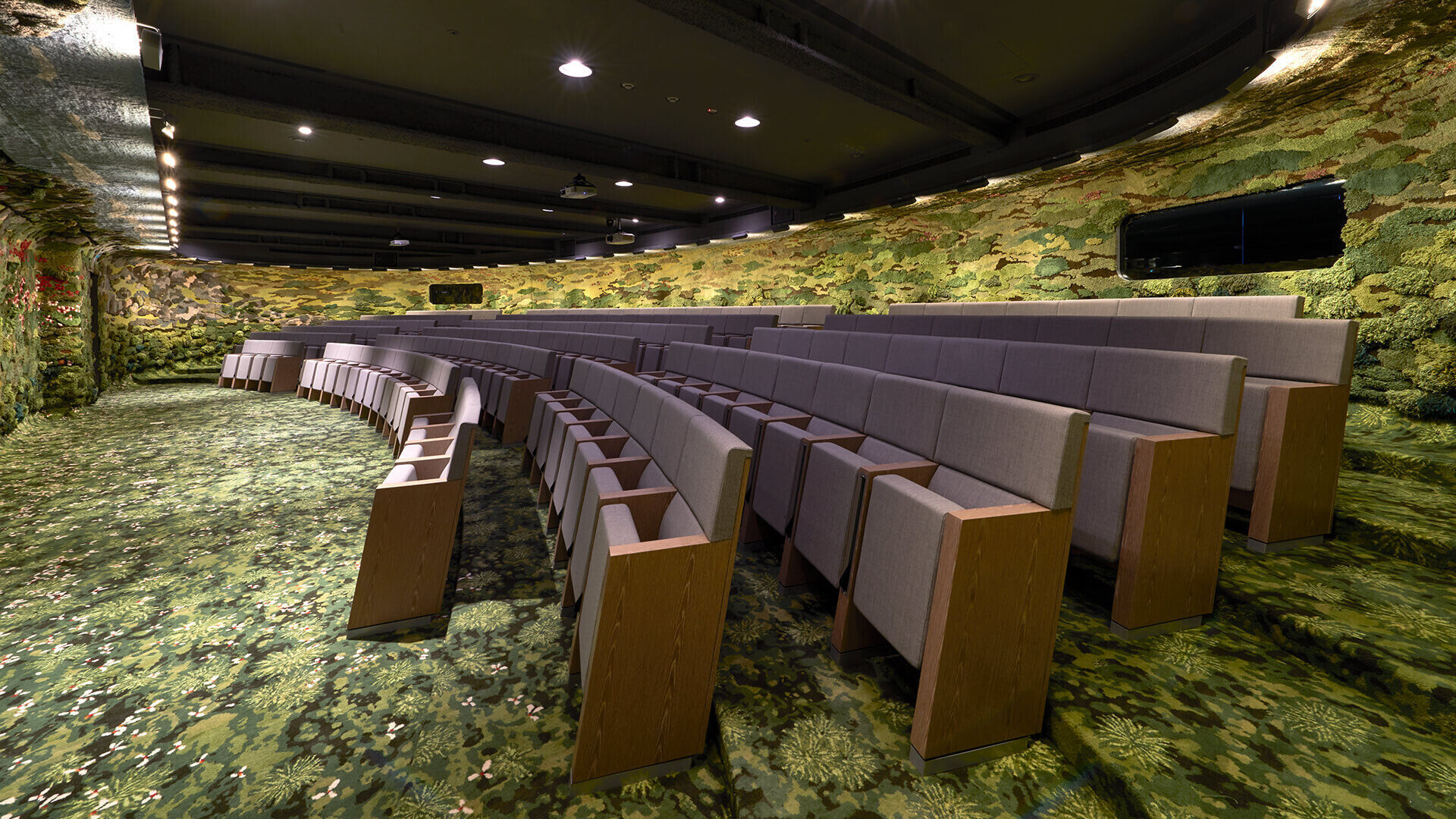
“The interior looks like a green dream surrounding the audience”, says Winy Maas, the co-founder of MVRDV. The hall is a work of art, which represents Taiwan natural landscape and, at the same time, meets the functional requirements of acoustics.The key element of the new lecture hall is the outstanding wall covering inspired by nature, created by Alexandra Kehayoglou, an Argentinian textile artist who transformed Jut Group lecture hall into a functional, comfortable and great impact space.
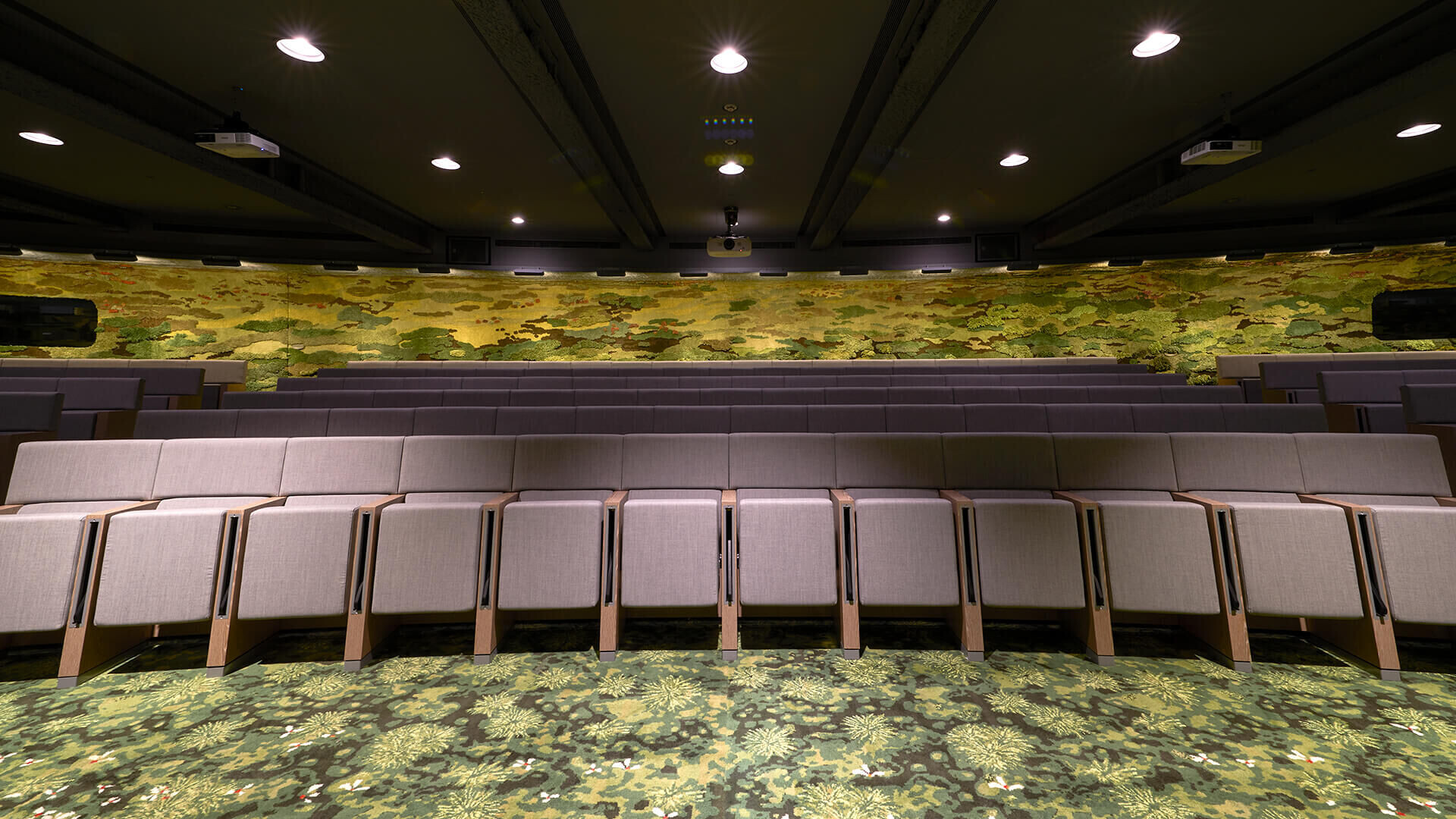
Designed as a real art installation, the structure has been manufactured in Buenos Aires at the weaving mill of Kehayoglou’s family, by using waste yarn and a handmade quilting technique, which has taken more than a year of work. By reproducing natural elements such as musk, water, trees and meadows, the covering creates a fabric wood, which extends from the floor to the walls, thus offering a unique atmosphere.
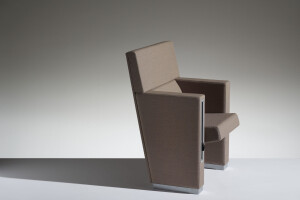
To arrange the lecture hall, MVRDV architecture practice has chosen the L213 armchairs by LAMM, standing out for their linearity and compositional rhythm, but also for their extreme comfort, into the original layout.
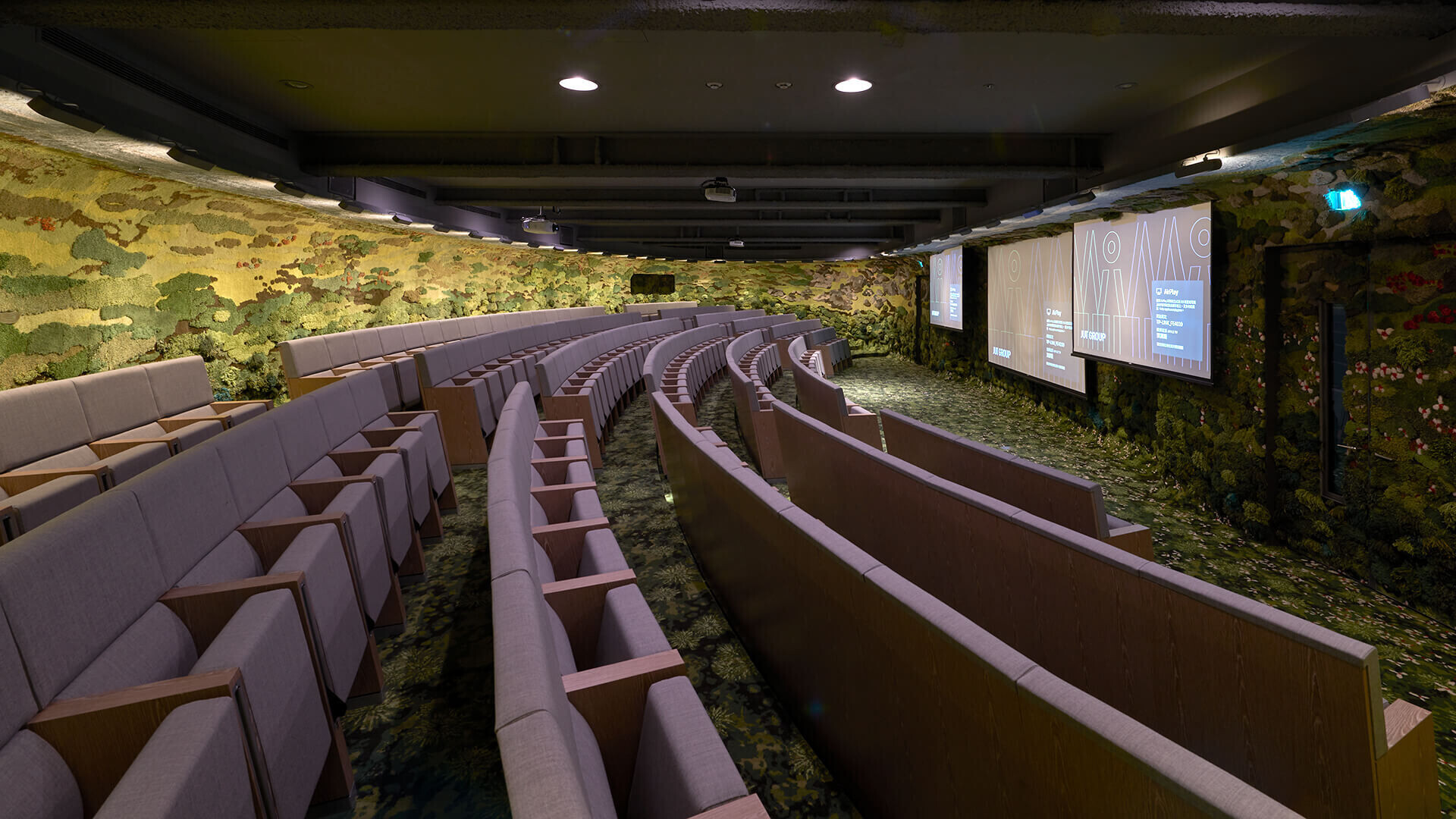
L213 armchairs, upholstered with Remix 2 fabric by Kvadrat, have been supplied in the version with inclined sides and installed in curved rows, with no gaps between the panels in order to ensure the backrest continuity. Sides and rear-backrest are made of plywood with grey oak finish. Moreover, the right sides are equipped with tip-up writing tablet with anti-panic movement.


