The La Conner Swinomish Library serves the coastal communities of Skagit County, Washington, and reflects a collaborative effort between the Town of La Conner and the Swinomish Indian Tribal Community. Situated on a prominent corner of the town’s main entry street, the building replaces a smaller facility and provides expanded public services within a compact footprint.
Located within a FEMA floodplain, the main occupied level is elevated four feet above grade. Site constraints and parking requirements limited the overall building size, resulting in a total construction budget of approximately $3.3 million, including site and frontage improvements.
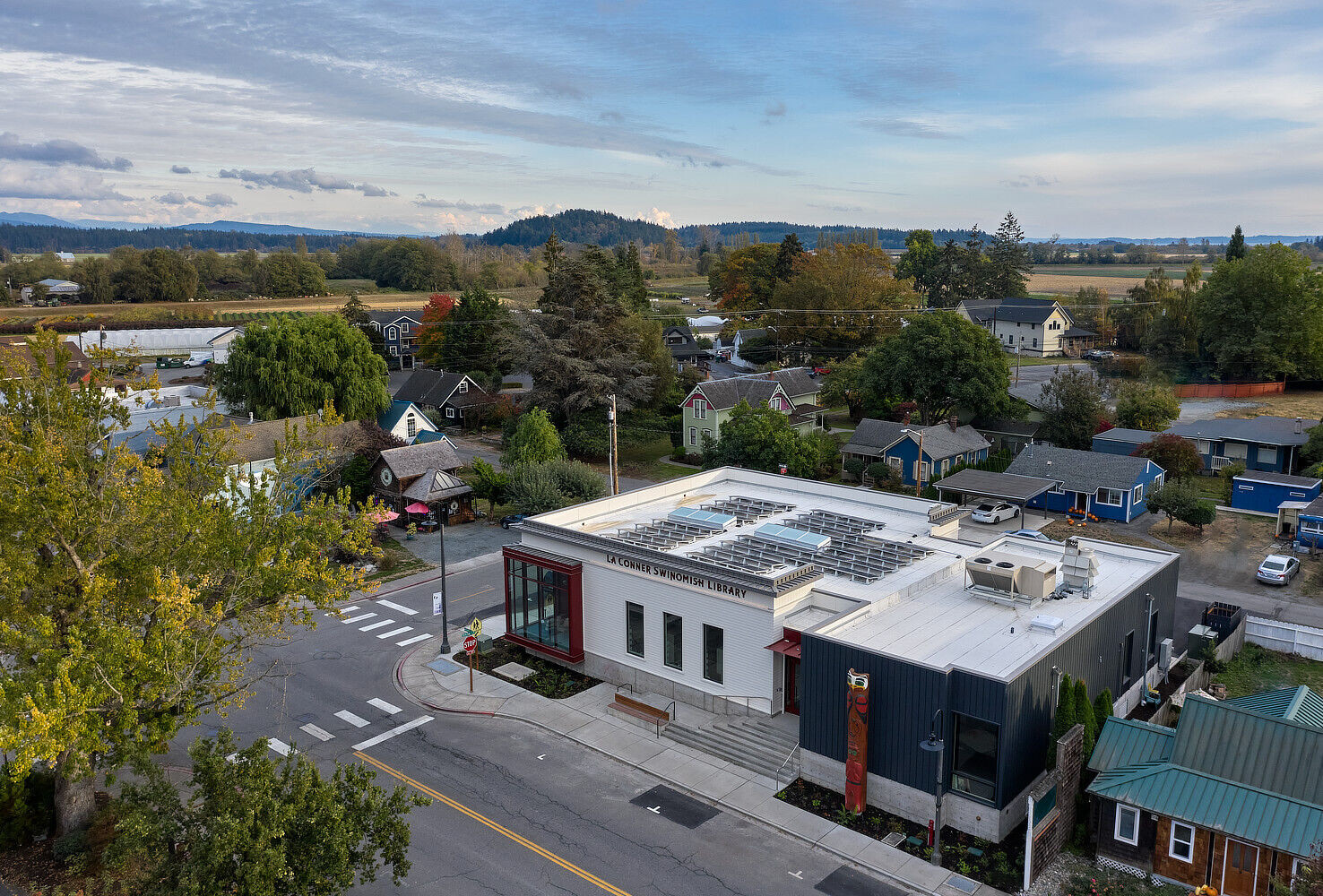
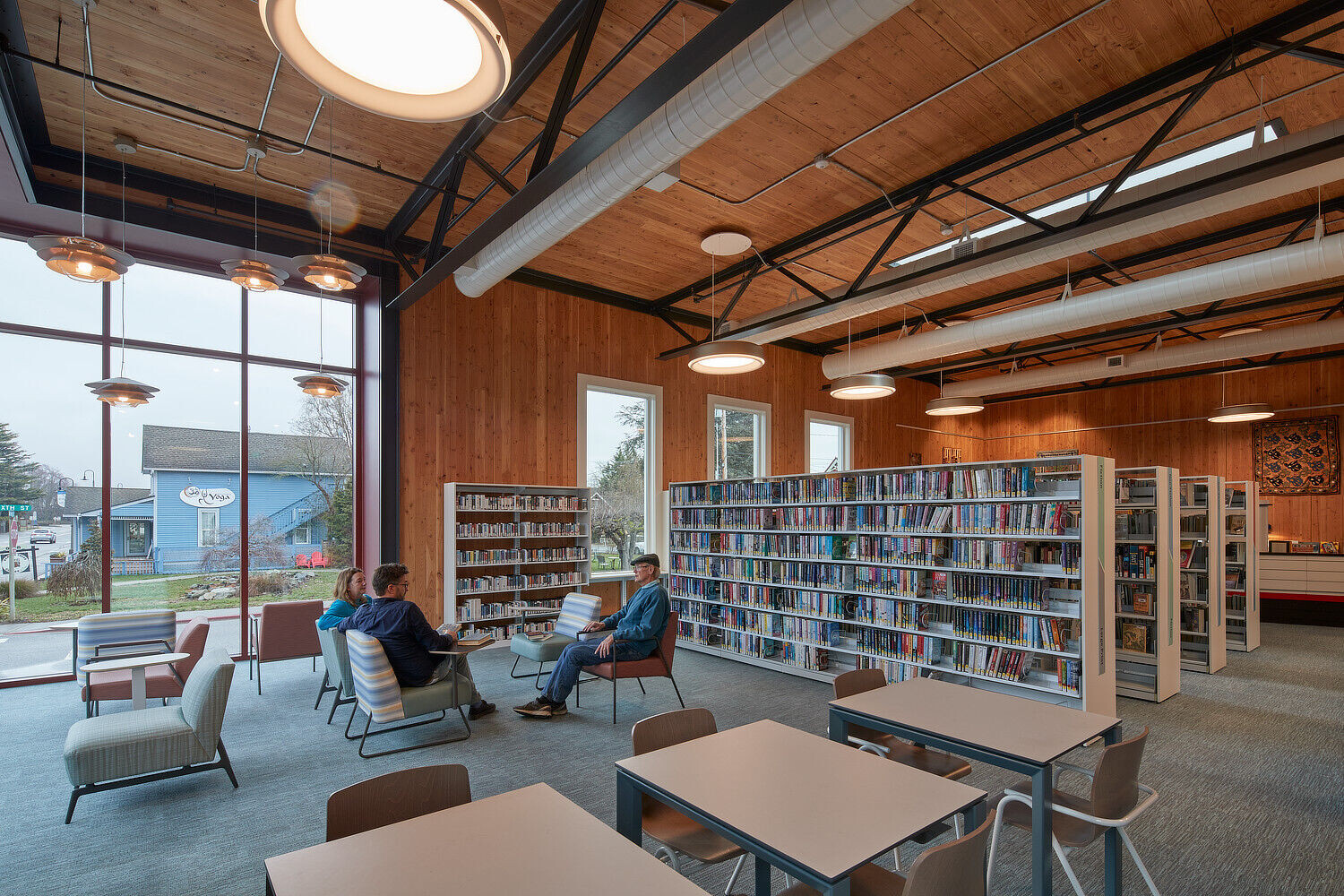
Despite these limitations, the project incorporates a number of environmental strategies while providing dedicated areas for children, teens, and adults, a meeting room, public computer access, and staff workspaces.
Interpreting the historic town context
The library’s architectural character respects La Conner’s historic commercial district, governed by local and national design guidelines. The design team conducted a photographic survey of historic buildings to identify recurring patterns such as small-scale street massing, tri-part facades, vertically proportioned windows, projecting bay elements, cornices, and wood siding. These elements were reinterpreted to inform a contemporary civic building that respects the town’s historic streetscape while integrating modern construction technologies.
During the design process, the library administration partnered with the Swinomish Tribe, creating an opportunity to integrate Indigenous cultural references. Consultation with tribal members led to revisions in the building massing and facade and the installation of a carved story pole at the entrance.
The pole, crafted by a Swinomish elder, comprises three figures: a welcoming man, two circling salmon symbolizing shared resources, and an eagle representing knowledge. These elements, along with interior and exterior colors, materials, and artwork, position the library as a welcoming place for sharing and learning. Interior signage is presented in English, Spanish, and Lushootseed, acknowledging the language of the Swinomish and other Coast Salish peoples.


Mass timber structure and embodied carbon
The library design is focused on the use of cross-laminated timber (CLT) panels for the building's primary and secondary structure. Manufactured in Washington State using locally sourced Douglas fir, the CLT panels are fully exposed inside the library, creating an interior environment that connects patrons to the nearby forests and references traditional Coast Salish architecture.
CLT panels form the exterior walls, interior partitions, floors, and roof, creating a unified structural system that reduces reliance on conventional steel or concrete framing. The panels were prefabricated and installed rapidly, allowing the building enclosure to be assembled in approximately three days. This prefabrication process reduced construction waste and shortened site construction time.
Mass timber contributes to lower embodied carbon compared with typical structural systems. Wood products store biogenic carbon captured during tree growth, allowing the structure to function as a carbon reservoir throughout the building’s lifespan.


Energy performance and operational emissions
The project achieved LEED Silver certification through a combination of efficient building systems and renewable energy generation. A rooftop photovoltaic array produces on-site electricity, offsetting a portion of the building’s operational energy demand. The envelope incorporates continuous insulation and air-barrier systems from manufacturers including PROSOCO and VaproShield, improving thermal performance and reducing heating loads.

Daylighting is introduced through skylights manufactured by Crystalite and glazing systems incorporating SunGuard low-emissivity coatings. These elements reduce artificial lighting demand while maintaining visual comfort for reading and study areas. Heating and cooling are provided through mechanical systems from Daikin and Mitsubishi Electric. Electric vehicle charging stations are also included to support lower-carbon transportation options.

Interior environment and material health
Interior finishes were selected to support indoor environmental quality and occupant health. Low-emitting materials and finishes minimize indoor pollutants, while daylighting improves visual comfort throughout the library. The exposed timber structure contributes to the interior while reducing material layers. Flooring and finish materials include products with environmental documentation, such as carpet tiles from Milliken and wood acoustic ceiling systems from 9Wood.
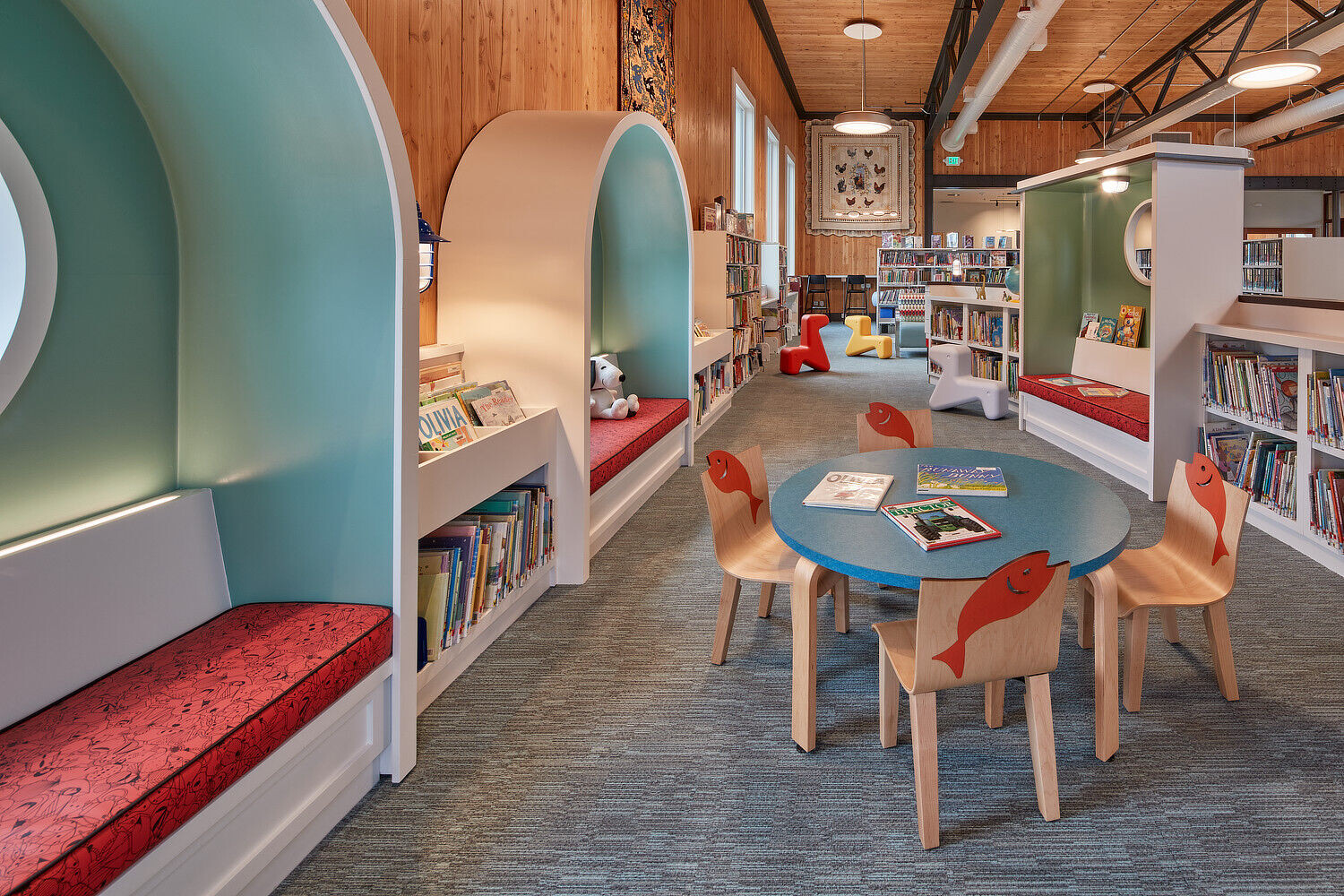
The library program offers spaces and services in a small footprint, including dedicated areas for children, teens, and adults, a large meeting room, public computers, and staff work areas. A custom-designed 24-foot-long tugboat defines the children's area, providing playful reading nooks and connecting the library to the town's historic working waterfront.

Adaptability and circular material strategies
The library’s primary reading room is designed as an open-span space without interior columns or fixed partitions. This arrangement allows bookshelves, seating areas, and program spaces to be reorganized as needs evolve.
The structural system supports future material recovery. CLT components can be mechanically disassembled and reused or recycled at the end of the building’s service life, allowing structural elements to re-enter material supply chains.


"When there are common interests and goals, native and non-native communities can find ways to work together and build relationships that help each other grow. That is what Swinomish and La Conner did with the construction of this library and our communities have grown closer because of it." - Swinomish Tribal Senator Brian Wilbur