


Gazechim Composites Ibérica company decides to build its new headquarters in the industrial zone of Picassent | Spain, teaming up with Graphenano engineering and onside architecture.
From the begging of the project onside has haven the collaboration of top companies in the sector of composite materials whose helped with experience and their “know-how” has still worked in the different constructive solutions.
The project would like to show nautical and aeronautical vanguardist sector applied in the building world, as well as free designs thanks to this type of compound material, where architecture is innovating new solutions by the last generation of nanotechnology of graphene.
The office facade is protected with a skin of slats organized as a wave with an appearance of swell like the surface of sea, above these ones float a “white bow” that sails on the building. The White Bow has a unbelievable geometry that highlights whit an almost “impossible” shape in its vertex, recalling the hull of a ship.
GRP type provides large doses of innovation and possibilities, previously inconceivable in the architecture and construction sector. Designs and proposals whose execution is only possible thanks to these new materials that allow to form implausible, capable of challenging the imagination.
Interior design of the office explores harmonies coexistence between the traditional materials and the latest generation composite materials, achieving warm and high-quality work environments.
Year: 2019
Site area: 5.200 sqm
Office area: 750 sqm
Location: Picassent | Spain
Client: GAZECHIM COMPOSITES IBÉRICA
Engineering: Grupotec
Construction: Construcciones Eliseo Pla
Partners: Graphenano Composites
Photography: Alfonso Calza
Prizes:
· Winner JEC FORUM CHICAGO INNOVATION AWARDS 2020
· Winner XIV PRIZES NAN 2020 Architecture & Construction
The White Bow
The White Bow

Applied products
Image gallery


Drawings


Renders


Project credits
Product spec sheet
Project data
- Project Year
- 2019
- Primary Building Material
- Other
- Building Area
- 750 m2
Featured sustainable Offices, Showrooms and Factories


The White Bow


A NEW DIMENSION WITH HYBRID GRAPHENE NANOCOMPOSITES
The White Bow, the latest architectural challenge with nautical inspiration
- Its 340 square metre cantilever is the largest in the world made entirely from graphene nanotechnology composites
- It is a project by the engineer Julio Cesar Galiana from Graphenano Composites in collaboration with the architectural firm Onside, for Gazechim Composites Ibérica
- In 2020 Gazechim, alongside Graphenano, presented the world’s first graphene boat
The White Bow is the latest Spanish architectural challenge, inspired by a nautical theme. It is a technological venture by the company Gazechim Composites Ibérica to introduce GRP-type composites into the world of construction, giving shape to this new type of architecture in their own headquarters, in the Picassent industrial estate in Valencia. The project is the fruit of the collaboration between the naval engineer Julio Cesar Galiana (Graphenano) and the architectural firm onside.
The project, which has won first prize in the JEC Innovation Awards Chicago in the construction category, and the NAN Award in the construction techniques and solutions category, aims to show off the vanguard of the nautical and aerospace sector applied to construction, as well as the freedom of design offered by GRP-type composite technology, indoors and outdoors, innovating in architecture with solutions that use the latest generation of these graphene nanotechnology composites.
“The White Bow is an example of unique geometry that juts out almost impossibly at its vertex, evoking the hull of a ship”, explain Carlos Bonet and Carlos Balada, from the architectural firm onside. “The brief was to showcase the technological advances of the nautical sector in architecture and construction, using raw materials that Gazechim Composites Ibérica work with. Ultimately, designing a building with a material that until very recently was inconceivable in construction, and that now, once it has been raised, demonstrates a high dose of innovation, showing the possibilities of GRP-type composites in architecture”, add the architects.
The largest composite cantilever in the world
The canopy over the loading bay of the logistics centre consists of a self-supporting structure with double curvature on a 340 square metre cantilever with no joints, making it currently the world’s largest piece made from the latest generation of graphene nanotechnology composites, as well as being the first application in the construction sector to use this carbon technology in the polymer matrix.
“Gazechim Composites Ibérica’s headquarters in Spain is the proof that smarter construction is possible, emphasising such important aspects as resistance, durability, innovation and sustainability. The use of graphene improves the mechanical properties of the composites, so there is no doubt that these two materials represent the present and future in many areas, and the idea was to be able to make it take shape”, explains Miguel Ángel Medina, director of Gazechim Composites Ibérica.
Gazechim Composites Ibérica’s headquarters combines the new architectural trend with the experience of naval and aerospace engineering, to give rise to a new type of architecture, as they have already done in other projects they have participated in, without sacrificing the habitability and functionality required of a workspace.
Fibreglass + Polymer + Graphene, the formula for lightness and resistance
Polymer materials by themselves do not provide enough resistance, so they need reinforcement to bring them rigidity.
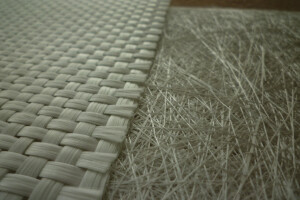
Fibreglass combined with a polymer was the first large strong and light structure documented in the history of materials. This was the start of the GRP-type composites industry.
In this project, graphene has been incorporated into the formula to boost its resistance, to achieve a construction that’s as robust as it is light.
Sustainable architecture
This design has only been possible thanks to the high ratio of resistance to weight of the composites, maximised through the use of the core made from Kerdyn™ Green 100% recycled PET, with excellent mechanical properties and a lower carbon footprint, thereby also helping to reuse over 12,000 PET bottles recovered from our oceans.
The project includes other elements that have been nanomodified with graphene, such as the 880 linear metres of GRP profiles distributed along the façade of the offices, forming a system of slats purposely designed to optimise the building’s energy response to solar radiation.
Indoor-Outdoor Composites
The indoor design of the offices explores the harmonious coexistence between the traditional noble materials and the latest generation composite materials. In contrast to the exterior image of the building, a palette of warm materials have been used, combining cladding of natural stone, wood, glass and large scale porcelain pieces, as well as natural paint with graphene.
KRION by Porcelanosa, McBath and Levantina are some of the partners that participated in fitting the interior with cladding, bathroom counters and furniture, key pieces where Gazechim’s DNA can be appreciated.
The building’s main stairway becomes the sculptural element that welcomes visitors and connects with the upper floor. Its banister is made from Krion, to obtain curved surfaces with no joints.
Simple distributions and wide spaces, where the textures of the materials and the natural light take centre stage, generating pleasant and comfortable work environments, in a natural backdrop and a healthy atmosphere.
Image gallery


Drawings


Renders


Gazechim Composites Ibérica is the Spanish subsidiary of the French group Gazechim, a company with a presence in 19 countries in Europe, the Middle East and the United States.
The company’s main activity is the distribution of raw materials for the COMPOSITES transformation industry in different markets, in particular, the naval; aerospace; automobile; wind energy; transport; pool manufacturing; sports; tank and piping manufacturing; and construction industries.
Gazechim collaborates with various technical firms to integrate materials and processes, making the most of its knowledge in research and development acquired in various markets over the years.
Not Available yet


