




Located on a small harbor in Amsterdam’s IJburg district, Jonas demonstrates a holistic approach to sustainability—merging technical innovation, biodiversity, and social well-being into a unified vision. The near-energy-neutral building incorporates 850 rooftop solar panels and a low-temperature heating and cooling system connected to the district network. It also uses a thermal energy system that draws heat and cooling from the nearby IJ lake.
Jonas provides 190 mid-market rental studios, 83 owner-occupied apartments, and shared facilities. Designed by Orange Architects for Amvest, with contributions from multiple partners, the project emphasizes community and sustainability.


Name and symbolism
The name Jonas references the story of Jonas and the Whale—symbolizing both adventure and protection within a “big body.” It is a heroic building with a warm heart, distinct from its surroundings in IJburg thanks to its headland site and multifaceted program.
The building reflects the site’s defining themes—water, quayside, and the craft of shipbuilding—embracing the “soul of the place” and making it visible.

Recognition
From the first sketch, the goal was to make Jonas one of the most sustainable residential buildings in the Netherlands. Using the BREEAM method as a benchmark, the project achieved the highest rating—BREEAM Outstanding—becoming only the second residential building in the country to do so. Jonas also received two 2020 BREEAM Awards: Homes Projects and Regional Award – Western Europe.

Technical and environmental strategies
Jonas achieves near-energy neutrality through 850 rooftop solar panels, a low-temperature heating and cooling system linked to the district grid, and aquathermy from the IJ lake. Passive measures—sun shading, natural ventilation, and a cooling water layer above the canyon skylight—reduce energy demand. Climate-adaptive systems include rainwater collection for toilet flushing and irrigation, green roofs to slow runoff, and vegetation to mitigate heat.


Nature-inclusive design
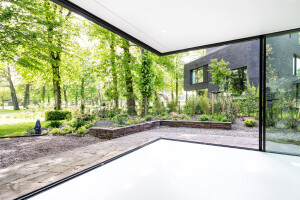
The landscape enhances local biodiversity through native riverside plantings, mussel reefs that improve water quality, and habitats including nesting boxes for birds and bats, plus a sand martin wall. A forest patio with mature trees and a rooftop beach with water features create shaded microclimates and inviting outdoor spaces.

Spatial strategy
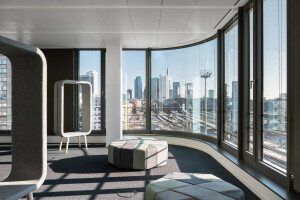
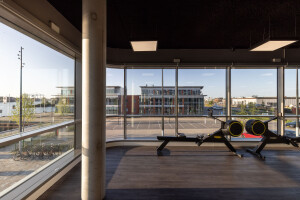
Jonas combines compact private studios of 42 to 50 square meters with generous communal spaces—living room, cinema, yoga studio, guest rooms, workspaces, and rooftop bar—all coordinated by a community manager to foster social interaction. The landscape design includes a forest patio, publicly accessible forecourt, and dune-like roof terraces that strengthen the relationship between building and environment.
The building’s dark, pre-patinated zinc façade, with its undulating windows and diamond-shaped form, lends a sculptural yet rational, familiar yet innovative character.


Inspired by traditional wooden ships, the interior uses rib-like trusses to create generous communal spaces such as a canyon-like atrium and rooftop beach. A timber pavilion, forecourt, and waterside play areas extend the living experience into the public realm.
The real surprise of Jonas lies within: a warm, dramatic interior that embodies modern, sustainable community life. Its spatial concept, reminiscent of wooden shipbuilding, uses trusses to carve large hollows within the building’s shell, housing 273 apartments.


Material responsibility
Material responsibility was central to Jonas’s design. Eco-concrete with low-carbon cement and 25 percent recycled aggregates reduces embodied carbon by over 30 percent compared with conventional mixes. Locally produced CSC Gold concrete and FSC-certified timber further reduce impact.
Durable, recyclable pre-patinated zinc cladding elevates the façade. Parametric design optimized material use in structural components, while slim concrete floor slabs reduced concrete and steel volumes—positioning Jonas as a benchmark for responsible, innovative material use in housing.
Carbon performance
Jonas demonstrates strong carbon performance through detailed tracking of shadow price and carbon footprint during design and construction, even without a published life-cycle figure. The project scored perfectly on BREEAM assessments for transport, waste, water, and pollution. A 30–40 percent reduction in embodied emissions was achieved through eco-concrete and recycled materials, while operational emissions remain low through renewable energy, aquathermy, and passive systems.
These environmental initiatives benefit both residents and neighbors: a forest patio provides shaded microclimates, a rooftop beach combats heat stress, and mussel and bird habitats enhance biodiversity. Collectively, these measures lower carbon impact while improving quality of life and long-term value.


Circularity and adaptability
Jonas’s design and construction embraced circular economy principles, achieving a 97 percent recycling rate through separation into seven waste streams. Materials such as zinc, FSC-certified timber, and eco-concrete were chosen for recyclability and long-term value.
The ship-inspired truss structure allows flexible interior spaces adaptable to future program changes, complemented by collective areas such as the canyon, rooftop beach, and living room. Ground-floor commercial spaces add flexibility for evolving neighborhood needs.


This adaptive strategy extends to the integration of landscape and architecture, ensuring ecological resilience through native plantings, nesting boxes, a sand martin wall, and mussel reefs. Vegetation mitigates heat stress, while the canyon skylight and water features promote natural cooling.
Urban and landscape integration
Together with its surroundings, the building forms a “living landscape.” At the front, a public forecourt is bordered by a timber pavilion with stepped seating that doubles as a three-dimensional playground.
The pavilion also marks the entrance to the car park and serves as a platform for activities such as film screenings or outdoor events. The green exterior, shaded by trees, invites people to linger; in summer, a small city beach emerges at the water’s edge.

Social sustainability
Jonas is as much about community as it is about technical performance. Compact apartments are balanced by shared spaces that foster interaction and long-term resilience. A community manager coordinates resident access to facilities and activities with neighbors, making Jonas a catalyst for the wider district. By linking collective environments like pearls on a necklace, the design creates an inclusive living landscape that is both socially and ecologically resilient.


