Si minore. Lightness, precision and elegance in every detail.
Some projects are born out of technical necessity. Others from a formal intuition. Si minore was born from both — and also from something deeper: a sense of harmony, proportion and rhythm.
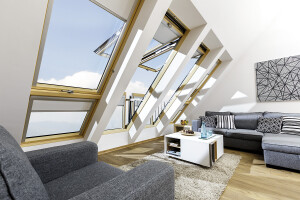
It is a system that escapes the logic of standardisation in search of visual lightness, structural precision and a modern elegance with a language of its own. Every detail is custom-designed: from the strongly bevelled profile to the hinge and the handle, specifically conceived to integrate with the form.

The name Si minore came during a suspended moment, in the midst of the lockdown, while listening to Bach's Mass in B minor (Si minore in Italian). And just like in a musical composition, this system revolves around a hidden balance — a subtle movement that guides the eye and the hand, without forcing.
The idea has deep roots. Sergio Capoferri had this profile in mind for at least twenty years. He had already created some earlier versions, but they were not fully convincing: the bevels were visible, but not as pronounced. With Si minore, the bevels become stronger, projected towards the inside and capable of visually lightening the mullion. Viewed from the front, the profiles seem to dissolve — and this lightness is part of the system’s charm.

The passage from idea to product involved several technical challenges. Hardware, profile machining and laminated timber composition all required study and precision. One of the most complex aspects was achieving a lined grain pattern on the inclined face of the timber profile. This required strict criteria in both the selection and composition of the lamellae.

The joints also required particular attention because of the bevels. Unlike industrial systems, which often use the same section for mullions and transoms, the components were sized so that the transom is slightly wider than the mullion, ensuring both functionality and elegance.

Another significant choice was the reintroduction of the cord hinge, used until the 1950s: beautiful, robust and fully integrated into the timber. It is not adjustable, and this requires great precision in both the construction of the window and its installation.
Finally, the handle. Since it had to be integrated into the bevelled mullion, Capoferri developed a new cremonese mechanism and a new design.

At the moment, the system has been realised for casement openings. Capoferri is also developing the lift-and-slide version and pivot systems, both vertical and horizontal. The lift-and-slide will be particularly interesting: the moving sash will feature bevels on all four sides, while the fixed one will be flush with the glass.

The company is also working on an external metal cladding, designed to further reduce the perceived thickness. One of the most visible achievements concerns the central joint. In the sliding version, it has been reduced from approximately 3.15 in to 2 in; in the two-sash casement version, from approximately 4.9 in to 3 in. The overall frame depth varies depending on the glazing, but the bevel remains constant at approximately 3 in.

Si minore achieves outstanding performance in terms of air, water and wind resistance.
Si minore was born for contemporary buildings. However, its application in historical contexts cannot be entirely excluded: it depends very much on the type of architectural constraint and, above all, on the client’s design courage.
It is a window with a strong, modern character — one that requires harmonious and captivating proportions.