Triodos Bank
Bert Rietberg

Circular architecture at its best

Applied products
View all applied products

The natural surroundings of the Estate were considered during the development of the new office. The design and construction are centred around principles of nature and biomimicry. Biomimetic architecture seeks solutions for sustainability in nature by following its set of principles and using it as a model, taking inspiration from natural designs and processes. Building heights have been adjusted to remain below the treeline. Bat flight routes were respected, and a special light plan was developed to prevent disorientation and to protect fauna. 


The energy-neutral building consists of sustainable materials and a demountable, wood-hybrid construction, which was designed by Rau Architects and constructed by JP van Eesteren. This creates the possibility to completely disassemble and reconstruct the office at another location. The project also includes a BIM-based Material Passport: this provides a record of all the materials used within the building, which stimulates the re-use end of their first life. The extensive use of renewable energy - reflected in over 3,000m2 of solar panels, the world’s first and largest bidirectional solar charging point for 120 electric cars, as well as heat and cold storage - contributes to the energy neutrality of the building.  


The interior reflects the beauty of the surrounding landscape. The choice of organic forms, refined materials and soft use of colour, ensure a natural stillness upon entering the building and reinforce the fusion with the environment. The wooden cores and ceilings inspired by the shape of a mushroom emphasise nature from outside and lead to an integrated refinement in the building. By choosing as few materials as possible, a maximum experience of the larger whole is created.

Aside from its outstanding construction and design, the value of the new Triodos office is the new impulse it delivers to its natural surroundings; a true reflection of the values of Triodos, one of the world's most sustainable banks. The company will move into the building in November.

Project credits

Architects
Design consultant
Interior Architects
Manufacturer of (revived) office furniture
Furniture
Facade elements

Product spec sheet

Manufacturer of (revived) office furniture
Furniture
S32 by Thonet
Facade elements
Composite facade ele... by Concrete Valley
Facade Engineer

Thonet furniture features throughout the new Triodos Bank offices

Thonet furniture features throughout the new Triodos Bank offices
Chris van Koeverden
Applied products
View all applied products

The futuristic new office building of the eco-conscious Triodos Bank in the Netherlands is an impressive marriage of sustainable architecture and modern working practices. A team drawn from RAU Architekten and interior architects at Ex Interiors worked closely with the project designer Gispen and the bank’s own staff to achieve this cohesive vision. The result is a unique, energy-neutral building on the large De Reehorst estate in Driebergen that sits in harmony with nature and which focuses on enhancing communication and bringing people together.

The new flagship building, which observes all the principles of the circular economy in construction, is designed to nestle organically within its landscape of greenery. Much of the furniture selected for the interior is drawn from the renowned Thonet portfolio, with its 200-year track record of designing for the meeting, socialising, working and living spaces of our lives, specifications that further emphasise the ‘communicative’ character of the new Triodos offices. More than 130 of Thonet’s classic pieces in bentwood and tubular steel furnish the working and mingling spaces, a choice in keeping with the architect’s environmental approach and preference for natural materials. The result is a perfect meeting of eco-friendly construction and sustainable furniture.

With its new corporate premises, Triodos Bank has created a monumental work of architectural art that invites nature, culture and economy into harmony. Recycled materials and the conscious use of the resources available reflect the commitment to circular construction practices. Particular attention has been paid to ensuring a supply of healthy fresh air within the building, as well as natural light, comfort and acoustic quality. The result is a particularly energy-efficient structure that has been described as ‘a cathedral of wood’ and which blends elegantly with its natural environment.

The principal frame is constructed entirely of timber, and, according to Triodos Bank Managing Director, Matthijs Bierman, the overall effect reminds him of the shape of a mushroom. The light, airy internal spaces appear to merge seamlessly with the surrounding woodland through expansive glazed walls. The generous application of wood and glass, with linen accents to attenuate the acoustics, produces an inviting effect that welcomes the natural world inside, providing staff, clients and visitors with a biophilic space in which to meet and relax. 

Sustainable pieces from Thonet furnish the interiors, complementing this overarching holistic approach. Thonet’s durable design icons became the perfect solution to the company’s desire for a consciously designed space that is conducive to communication.

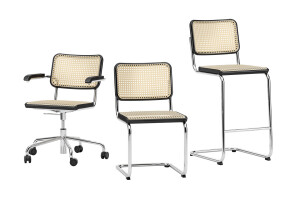
In keeping with the precise selection of construction materials, the office and common areas are furnished with more than 100 Thonet classics made from tubular steel and naturally stained bentwood with canework. The iconic Marcel Breuer S 64 V tubular steel cantilever chair and its new refinement, the S 64 Atelier swivel chair version, which was added to the portfolio last year, represent 54 of the building’s individual seating options. In addition, the restaurant area offers 76 of the famous model 218 bentwood bistro chair, made according to the Gebrüder Thonet design from 1876.

The seating is completed by several of Stefan Diez’s contemporary 404 H bar stools stained in black. Thanks to their clean, minimalist aesthetics, all the chairs in the Thonet portfolio can be used in a wide range of settings – an essential prerequisite in modern office buildings. The project’s Chief Interior Architect Odette Ex (from Ex Interiors) had specific criteria in mind when making her selection of furniture, such as durability, quality and a stylish, modern appearance.

As she explains, “The model 218, in particular, is a complete design classic. But its elegant shape is also perfect for contemporary interiors. The chair looks modern in any setting and it retains its design value. We had previously specified this model for the former Triodos Bank corporate offices, since its timeless look meant it could be used effortlessly again and again in subsequent interiors.” As a result, visitors to the newly designed corporate base can take their seats not only on brand new Thonet pieces, but also on refurbished chairs from the former company building.

Brand description
The unique success story of Thonet began with the work of master carpenter Michael Thonet (1796-1871), which established the transition from manual furniture production to industrial production. Michael Thonet succeeded in making the breakthrough to industrial production in 1859 in Vienna with chair No.14, later called the „Vienna coffee house chair“, for which the innovative technique of bending solid beech wood was used. The individual production steps were standardized and the division of labor concept was implemented for the first time in furniture production. In addition, the chair was easy to disassemble and could be shipped in a space-saving way. Chair No.14 cleared the way for Thonet to become a global enterprise, and numerous successful bentwood designs followed. Thonet’s production peaked in 1912: that year, two million units were produced and sold worldwide. Tubular steel furniture is the second constant in Thonet’s product line. In the 1930s, the company was the world’s largest producer of this innovative furniture, which was designed by a number of famous architects including Mart Stam, Ludwig Mies van der Rohe and Marcel Breuer. Today, the early tubular steel furniture designs are considered milestones in design history. Their clear, open and simple forms were an expression of a new attitude in every-day culture and architecture, which became famous under the catchphrase “New Objectivity”. Currently, numerous successful classic models are still in the product line, among them the first cantilever chair S 33 for which Mart Stam was awarded the artistic copyright for its form and basic principle, as well as models S 32 and S 64 by Marcel Breuer. The family company has had its head offices in Frankenberg in the north of Hesse. Today, all bentwood and tubular steel classics as well as the contemporary collections are produced here in a facility with cuttingedge production equipment and a staff of workers with vast experience to draw upon. Thonet still develops innovative products that stand out due to their quality materials and timeless formal language and always take sustainability and durability under consideration.
Products applied in Commercial

A sustainable, fully-circularly furnished building with a remarkable impact

A sustainable, fully-circularly furnished building with a remarkable impact
Chris van Koeverden
Applied products
View all applied products

At the Reehorst estate in Driebergen, a wooden cathedral has arisen which completely blends in with its surroundings. The new Triodos Bank branch has an affect on everyone who visits, works on confers here. Peace and quiet, serenity and being one with nature occurs and is present all around. Interior designer Odette Ex: “Its tranquillity is what makes this building breathe.” Triodos Bank, RAU Architects and Ex Interiors worked together on this Gesamtkunstwerk for seven years. Gispen furnished the building and created a fully circular interior. 


The Triodos Bank is growing rapidly, which is why the bank has built a new branch on Landgoed De Reehorst, an estate right besides Driebergen-Zeist railway station, where the bank was established forty years ago. In keeping with Triodos' vision, it is a fully sustainable office building. The entire estate has been developed from a vision in which nature, culture and economy should be in absolute harmony with one another. The unique building, which perfectly blends with its surroundings, is the epitome of this vision and was crowned Office Building of the Year at the Architectenweb Awards 2019.


Distinct division of inner and outer ring
In a joint effort, RAU architecten and Ex Interiors developed a design concept for the new, five-storey office building. The large ground floor is semi-public; in addition to a restaurant, there is a meeting centre intended primarily for visitors. The first floor is all about collaboration, where employees can meet up and work on projects together, for example. This collaborative environment is clearly divided into an inner and outer ring; consultation areas are placed in the outer ring, where people feel closely connected to the surrounding nature. The pantries and concentration areas are situated in the inner ring. The workstations for the Triodos Bank employees are installed at the three towers. It also holds true for this area that the workstations are purposely oriented towards the surrounding nature, with an inner which is provided with a functional zone with pantries, phone booths and concentration zones.


Organic shapes, sophisticated materials
The building is characterised by its openness and transparency (working as if you were in the surrounding forest!) and an extraordinary reception of light. The organic shapes, sophisticated materials and subtle use of colour brings about a natural stillness when entering the building and enhances how the building merges with its surroundings. Interior designer Odette Ex who, in her own words, sculpted the building as an artist rather than an architect: “This is the perfect example of how interior architecture and nature fully reinforce one another.”

In touch with nature
Odette: “From the first moment on, we as a team wanted to create a building that connects heaven and earth. A design that interconnects with nature. If you ask me, this is exactly what circularity stands for: it's not all about materials, it also involves being in touch with nature. This is something we have drifted away from. It truly affects you when you are surrounded by genuine materials at your place of work. At the Reehorst estate, we wanted to create a healthy work environment in which we sought perfection but also embraced imperfection. It was precisely the vulnerability of everything that we wanted to show. We installed linen walls to improve the acoustics, for example. By selecting materials based on their authenticity, an extra dimension was added to the building, creating an integrated design which contributes to the peace and serenity of the building.”


Circular highlights
It was up to Gispen to completely furnish the building in a circular manner. We supplied all the separate pieces of furniture, which were partly new, and partly reused and refurbished. In addition, we provided many custom solutions. Our carefully selected team realised the delivery of all the furniture within 5 weeks.

Approximately 400 existing workstations are reused. We were able to reuse the frames, refurbish all the tabletops and added clever components to the desks to neatly and safely tuck away any wires and cables. All the oval conference tables were upgraded. One eye-catching conference table of no less than 7 metres and 20 centimetres long was shortened to 6 metres and was refinished. Moreover, all the existing seats have been reupholstered. Gispen CIMO is installed in the special cubicles: our circular, modular desk collection with cradle-to-cradle certified office chairs by Herman Miller.

Highlights of the many custom solutions which are realised: a long tailormade wooden workbench, a cabinet made of tree trunks, a wooden stand on both the ground floor and the first floor and two tables made of concrete ciré on the ground floor.

Brand description
Gispen is our name. Gispen stands for sustainable design. We create environments that have a positive influence on people, as well as encouraging others to handle resources responsibly. We have been doing so for over 100 years. Together with our clients, national and international designers and architects, partners and suppliers we create surprising and sustainable solutions for office, healthcare, education and hospitality environments. We have opted for circular design, manufacturing and entrepreneurship.
Products applied in Commercial

Triodos Bank

Triodos Bank
Bert Rietberg: J.P. van Eesteren

For this new circulair and sustainable headquarter of Triodos Bank in Zeist, we produced 350 double-curved composite facade elements and canopies. Just like the building, these elements are detachable. 

Brand description

Concrete Valley is a business park with several independent and distinctive companies. Each company has its own unique expertise, knowledge and experience. Together they offer a full range of precast products, from standard precast concrete elements to complex challenges and bespoke solutions. THINK IT, SEE IT, MAKE IT.

microbeton: specialist in ferrocement, makers of lightweight elements. microbeton develops innovative lightweight ferrocement elements for commercial and residential construction. Waco: With over 100 years of experience, Waco is the leading specialist in structural precast concrete products for the civil engineering, construction and petrochemical industry. mbX: specialist in glass fibre reinforced concrete and high-performance concrete, makers of geometrically complex elements. Timber Structures: Specialists in woodwork, makers of timber products and moulds. Timber Structures is the in-house modelling shop that provides all the Concrete Valley companies with the best mould.

Products applied in Commercial
References UNS RAU
Share or Add Triodos Bank to your Collections